Renovation software for estimating, variations and progress claims
Scan the room, price the reno, and claim each stage before the tiler packs up.
Estimate kitchens, bathrooms, extensions and whole-home renos from your own cost catalogue, carry selections as PC allowances, log variations the moment a wall comes open, and claim each stage on a GST invoice clients pay online. Core from $0 to $69/mo, plus the Builder Suite estimating add-on at $99/mo, replaces Buildxact + Xero + Dropbox.
Free plan, no card needed. GST, ABN and your licence number on every quote and claim.
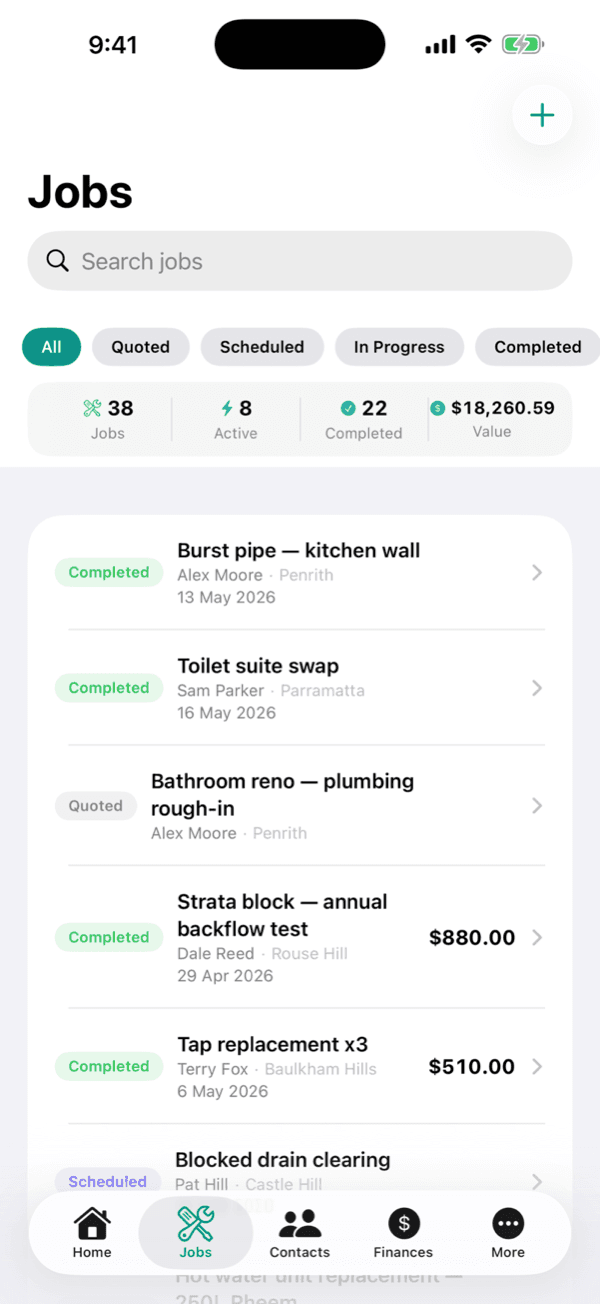
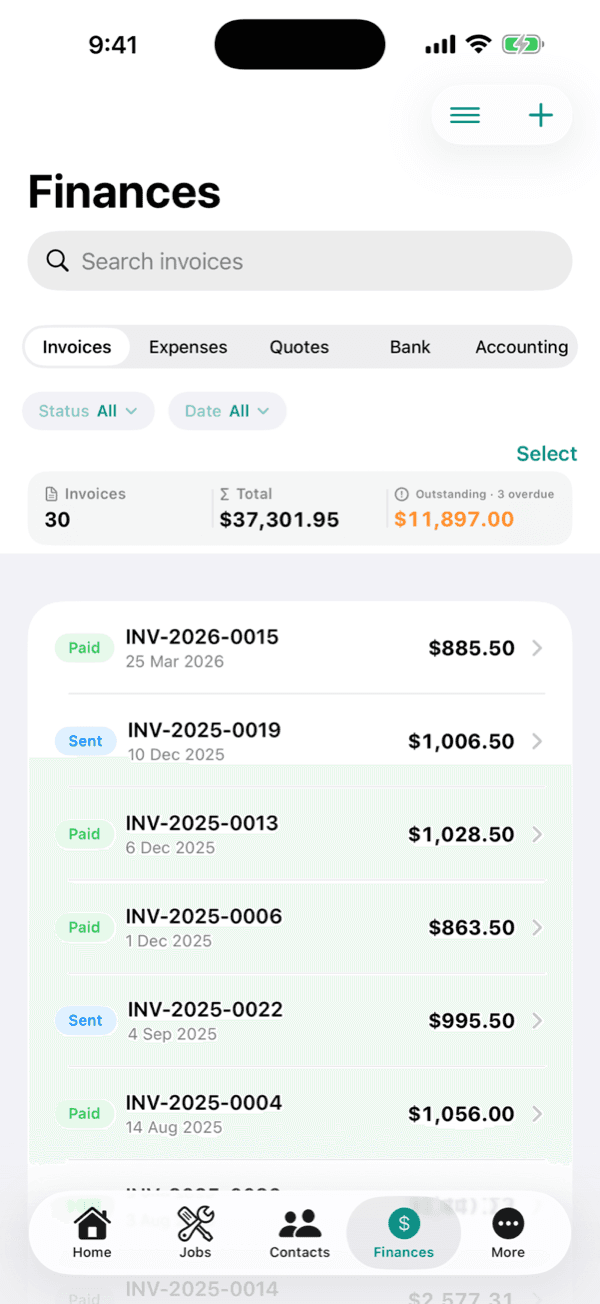
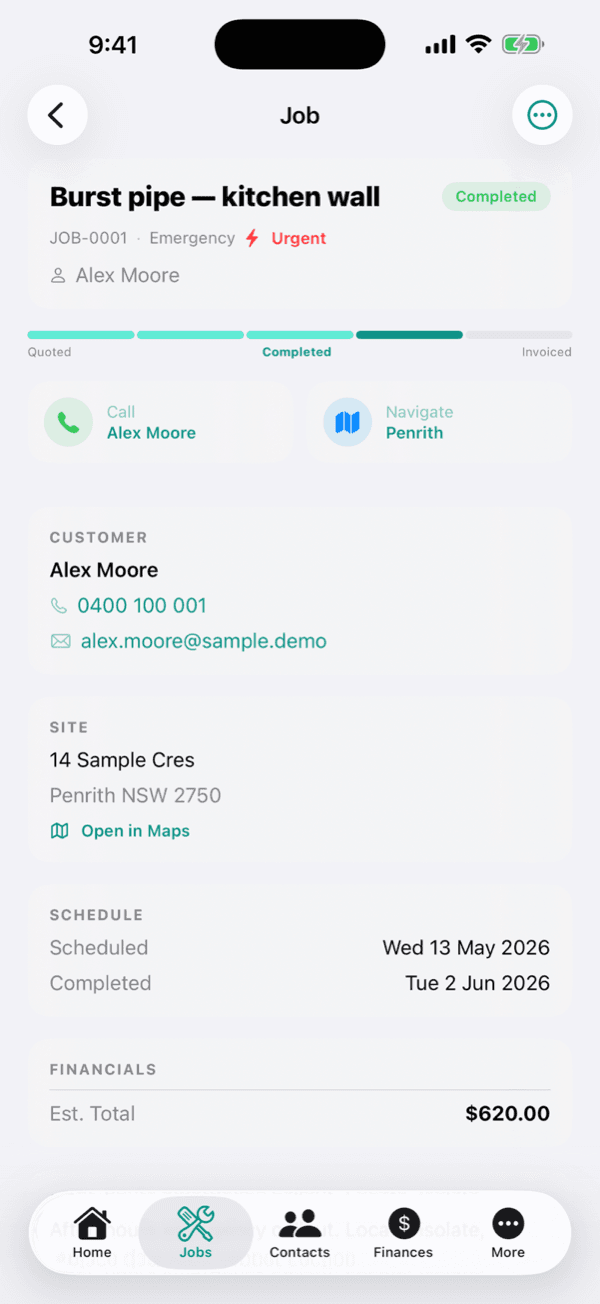
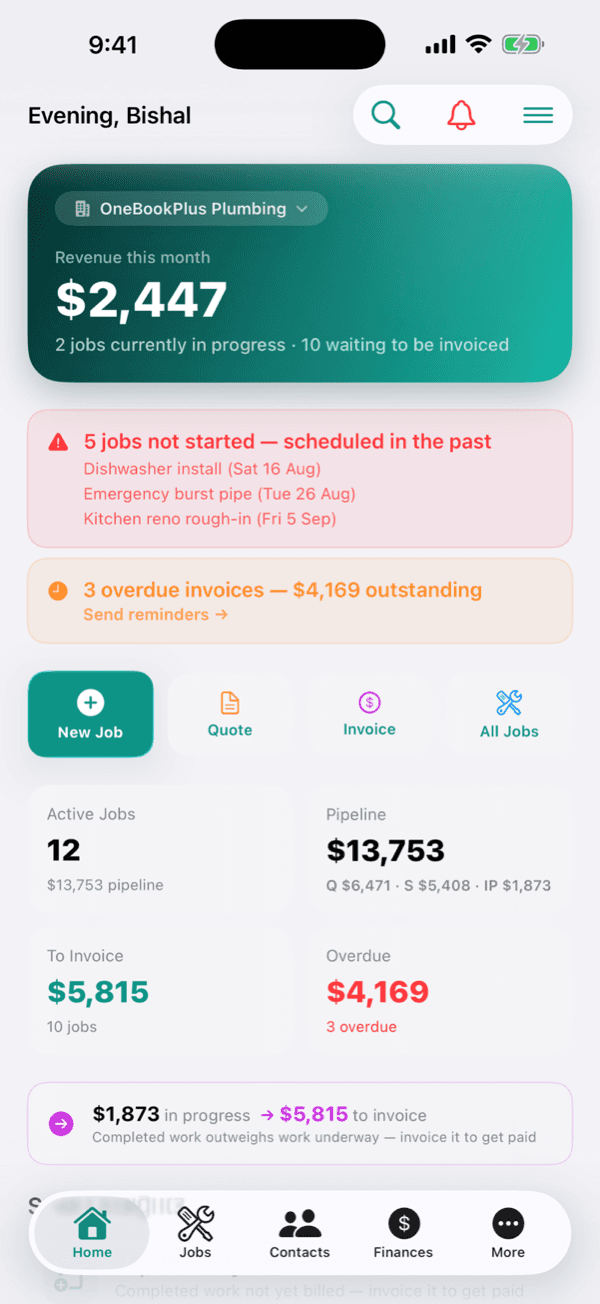
Cut $126+/mo from your software stack by replacing Buildxact + Xero + Dropbox + a booking tool with OneBookPlus and Builder Suite. Vendor prices verified 2 August 2026.
See the pricingFree Tools & Resources
Reference material for renovation sole traders and small crews
Start a Trade Business
8-step founder guide, ABN, GST, licence, White Card, insurance, tools, pricing, first clients.
InteractiveTradie Quote Calculator
Interactive estimator combining hourly rate, materials markup, travel, callout, and GST.
ReferenceTrade Licence by State
State-by-state thresholds, regulators, and invoice requirements for AU trade licensing.
Operator GuideBuilding & Construction Award
Plain-English MA000020, CW/1 to CW/10, industry/tool/fares allowances, RDO system.
ReferenceTradie Insurance Guide
PL, workers comp, tools, vehicle, PI, home warranty, contract works, coverage and premium ranges.
Key takeaways
5- Renovation and remodelling work in Australia is licensed at state/territory level, with the requirement, and mandatory home-warranty insurance, depending on the work type and contract value. Show your builder licence and warranty details on quotes and invoices where they apply.
- Renos are won and lost on two things generic job apps ignore: variations (the rot behind the wall, the mid-job change of mind) and selections carried as PC sums and provisional sums (tiles, tapware, benchtop). OneBookPlus captures both so neither eats your margin.
Show 3 moreShow less
- Half the renovations you quote have no drawings. Scan-to-plan runs in the OneBookPlus iOS app on an iPhone Pro or iPad Pro with LiDAR, and captures a room's dimensions on site to start an estimate; when there are plans, AI plan takeoff measures the areas, runs and counts off a PDF or photo.
- Whole-home renos and extensions run on staged progress claims (demolition, frame, lock-up, fit-off, completion) with retention withheld on every claim and the total held always on screen, the single biggest lever on cash flow through a months-long job. The release claim is one you raise yourself.
- OneBookPlus is the all-in-one alternative to the typical renovator stack, Buildxact ($199/mo) + Xero ($37/mo) + a file-sharing subscription + a booking tool. Vendor prices verified 2 August 2026. Core is bundled from $0/mo (Free), $29/mo (Starter) or $69/mo (Growth); the Builder Suite estimating add-on is $99/mo for the whole business, with no per-seat charge for the app itself. Team logins stay banded by your core plan.
Built for how renovators work
OneBookPlus is the renovation business app for builders who spend their days pulling apart bathrooms and kitchens, with the estimate, the variations and the claims on the same job record.
Scan-to-plan room measure
Half the renovations you quote have no drawings, just a tired kitchen or a bathroom to gut. In the OneBookPlus iOS app, on an iPhone Pro or iPad Pro with LiDAR, scan the room on site and the measurements come back as a takeoff you check and then price into the estimate. There is no room scan in the browser. The scan is approximate (within a few centimetres), great to start the numbers, and you refine on the canvas. No LiDAR on your device? Snap a room photo instead and add measurements by hand.
Digital plan takeoff
When there are drawings, an architect's PDF for an extension or a second storey, upload the plan (PDF or photo) and AI measures it: floor and wall areas, runs and counts, dropped straight onto the drawing with a confidence score. Zoom, pan and drag any shape to correct it, then tap one symbol (a downlight, a power point) and it finds and tallies every other one. Accept the numbers you trust and price from them.
Learn more about Digital plan takeoffAI estimating
Describe the reno in plain words, "gut and re-do a main bathroom, retile, new vanity and screen", or speak it, and watch a full, sectioned estimate build in front of you, priced from your own cost catalogue and calibrated to what you actually pay your suppliers. A built-in reviewer flags missing items, pricing outliers and AU compliance gaps, and lets you add anything it finds with one tap. You review every line; the AI just does the first draft. Included with Builder Suite, not a separate paid add-on.
Learn more about AI estimatingCost catalogue and recipes
Keep your labour, materials, subbie and supplier rates in one catalogue, then build reusable recipes (assemblies), a bathroom strip-out, a waterproofing package, a kitchen fit-off, and drop them into every quote in one click. Every estimate stays grounded in your real costs and your markup, with wastage and allowances built in, so the fifth bathroom you price this month takes minutes, not an evening.
Learn more about Cost catalogue and recipesSelections, PC sums and allowances
Renos live and die on selections. Carry the tiles, tapware, vanity, benchtop and appliances as prime-cost (PC) items and provisional sums (PS) in the estimate, so the client sees a clear allowance for what they haven't chosen yet. When they upgrade to the imported stone, the difference becomes a variation instead of a hit to your margin.
Variations, on the spot
Open up a wall and find the joists are rotten, or the client changes their mind at handover, variations are the reality of every renovation. Log the extra scope and cost, send the client a variation for approval with one tap, and add it to the contract total once they say yes. A full audit trail of every change, so nothing gets done for free and nothing gets forgotten at invoice time.
Progress claims for staged renos
A whole-home reno or an extension rarely pays in one hit. Run it on progress claims against a schedule of works, demolition, frame, lock-up, fit-off, practical completion, each raised as its own GST invoice that draws down the contract value, with retention withheld at the percentage set on the contract and the running total held on the claims screen. Claiming the retention back at the release milestone is a claim you raise yourself. The balance owing is always clear, so cash keeps flowing through a job that runs for months.
Photos into a progress claim
Photograph what's done on site and AI reads the photos against your schedule of works, suggesting a percent complete for each stage, waterproofing at 100%, tiling at 70%. It drafts the claim for you to review; you check every stage and nothing bills until you send it. The claim goes out as a GST-compliant progress-claim invoice the client can pay online.
Learn more about Photos into a progress claimTrade and subbie scheduling
A bathroom is a relay, demo, plumber rough-in, electrician, waterproofer, tiler, then fit-off, and the whole job stalls if one trade slips. Schedule each stage and subbie on the week view, issue RFQs to lock in real subbie prices, and reschedule with a drag when a supplier is late. Reminders keep the client and the crew in the loop so you're never the last to know a trade didn't show.
Before and after site photos
The before shots sell the after shots. Capture the existing kitchen, the wall you opened up, the waterproofing before it's tiled over, and the finished room, all attached to the job record, timestamped and organised by stage. A documented trail for the client, for the certifier, and for the portfolio that wins your next reno.
GST invoicing, BAS and online payment
Every quote, progress claim and invoice calculates 10% GST and shows your ABN and builder licence number, meeting ATO tax-invoice requirements. Clients pay the claim online by card or bank transfer (BECS), and the payment is recorded against the claim it settles. Come BAS time, your GST summary, collected on claims, credits on materials and subbie invoices, exports in one click.
Live cost control vs budget
Renos bleed margin in the gaps, the extra day the tiler needed, the skip you forgot to bill. Track committed costs, actuals and forecast against your budget in one view, with overrun alerts the moment a cost code trends over. You see a job slipping while you can still do something about it, not three months later when the accountant finishes the quarter.
Free core plan, no card needed. Builder Suite has a 14-day trial.
See it in action
The screens you work from, on site.
These are product screenshots: the job pipeline, the staged progress claim and the signed quote you'll run a reno on. Tap any screen to zoom in.
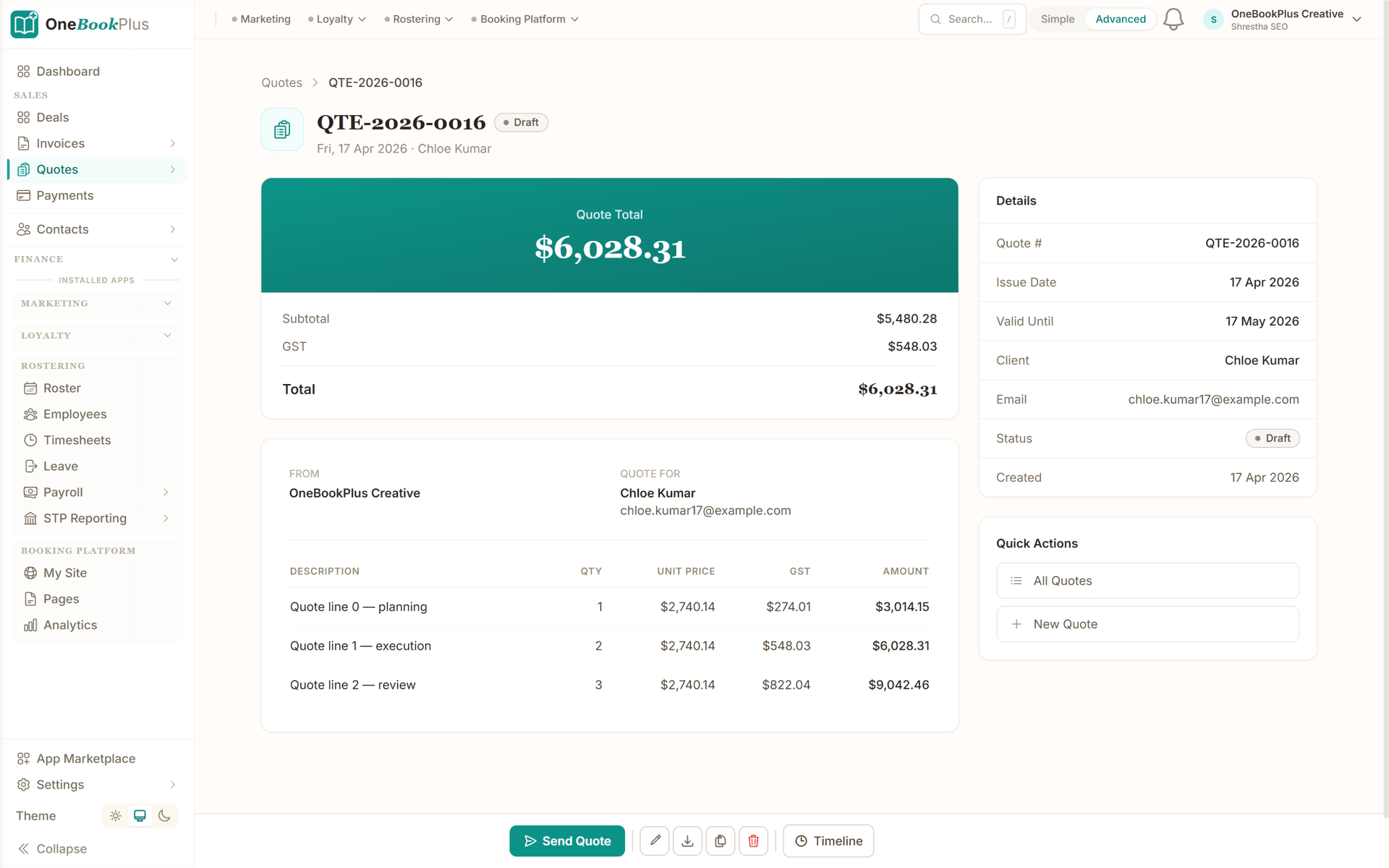
Quote the renovation, stage by stage
A quote with the total on top, subtotal and GST underneath, quantity, unit price and GST on every line, a valid-until date, and one button that sends it to the owner.
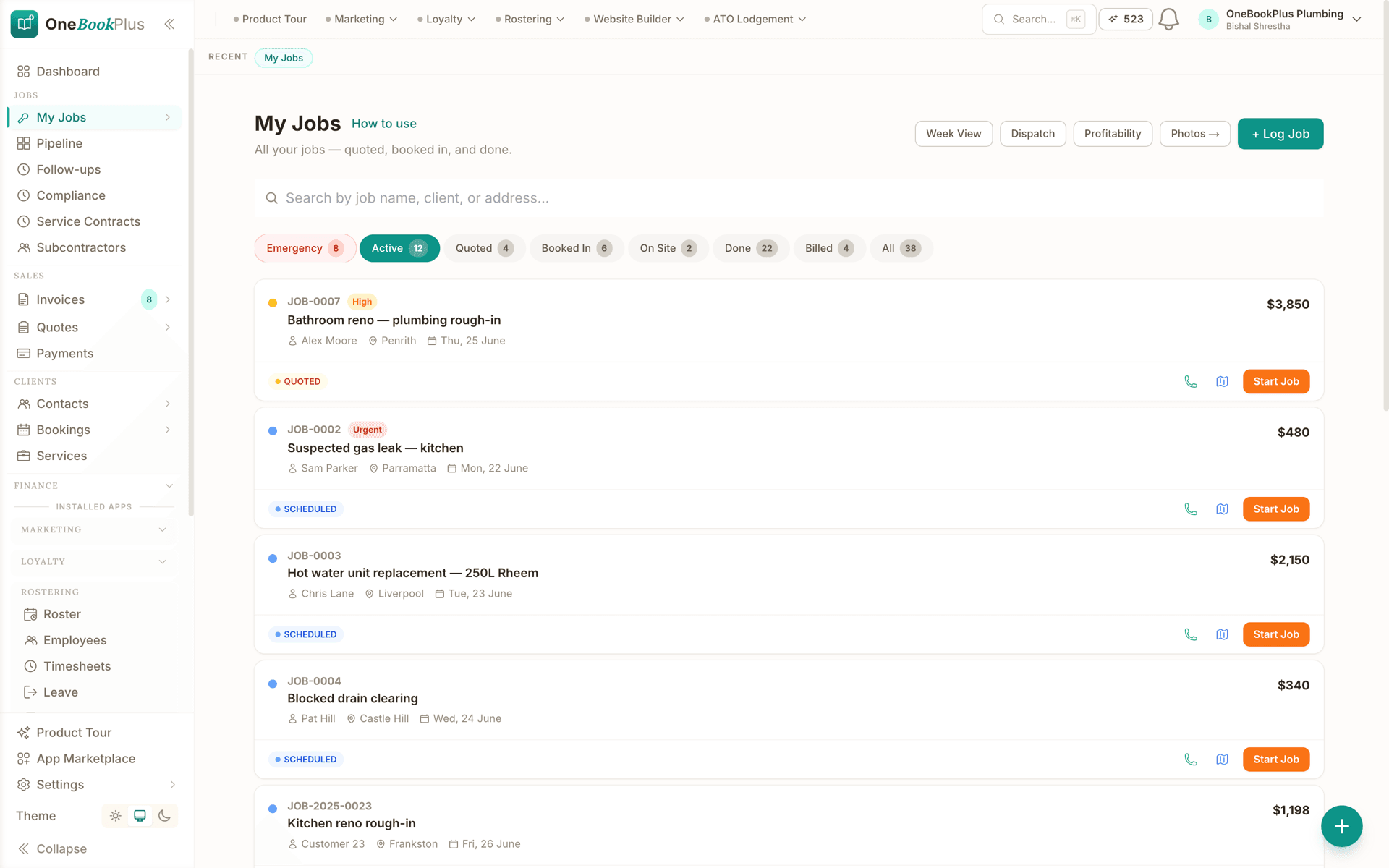
Every reno on one screen
The jobs screen filtered by emergency, active, quoted, booked in, on site, done and billed, each job showing the owner, the suburb, the day it is booked for and the value.
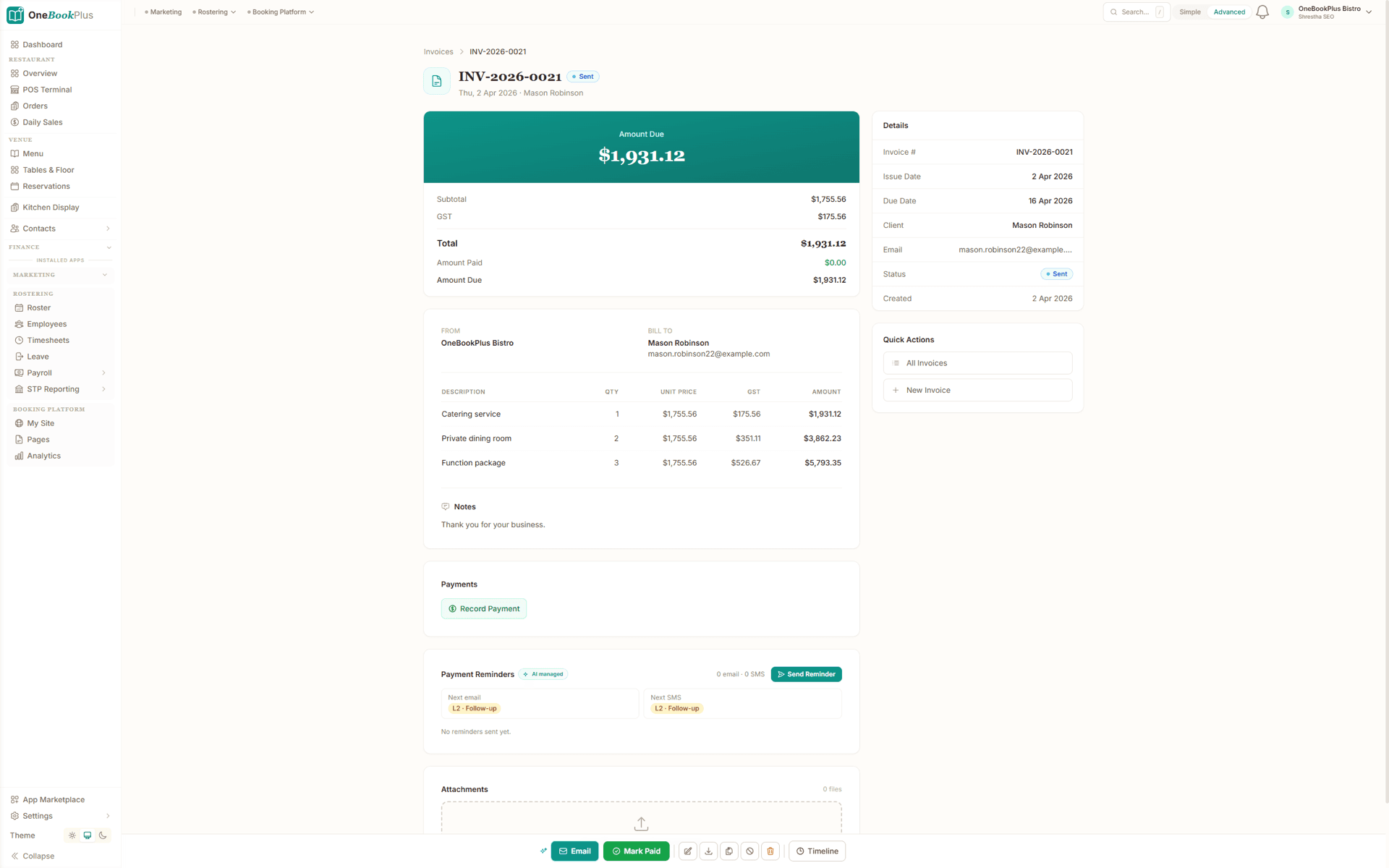
Claim the stage, and see what is still owed
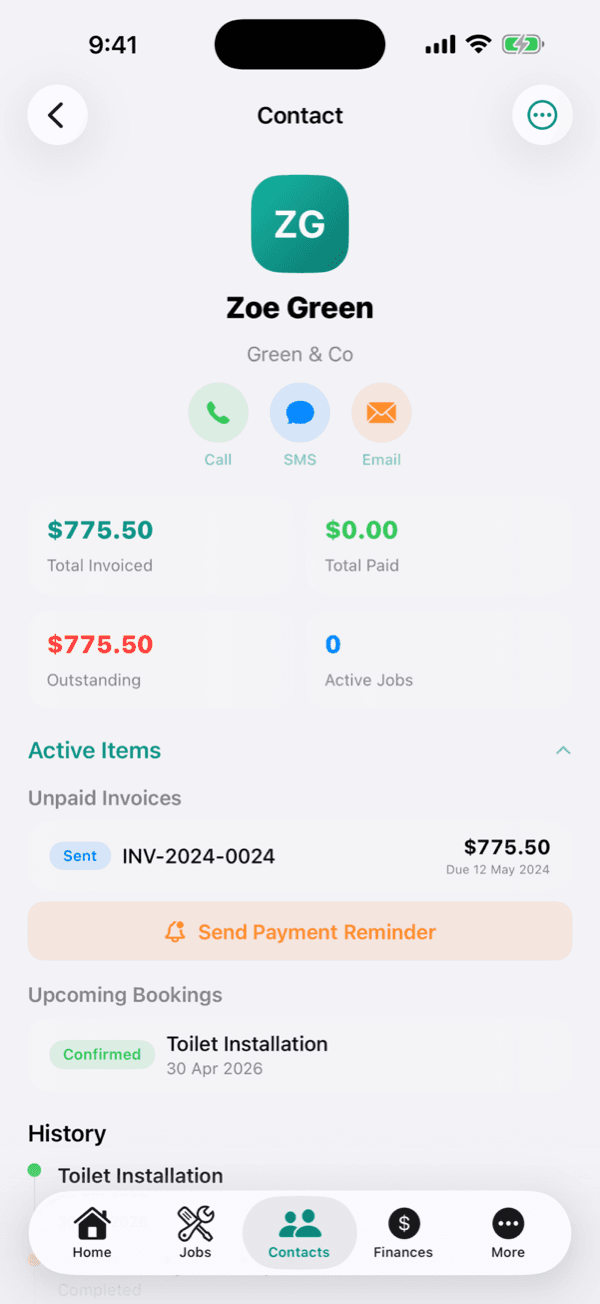
A GST invoice showing subtotal, GST, total, amount paid and amount due, payments recorded against it, and a reminder schedule that queues the next email and the next SMS.
The app
The app behind your renovation quotes
Builder Suite adds estimating, takeoffs and staged progress claims on top of your core OneBookPlus plan.
Builder Suite
$99/moEstimating to progress claims, on one platform
Builder Suite turns OneBookPlus into a complete build-management platform for custom-home builders, renovators and small commercial builders. Estimate from a reusable cost catalog of labour, materials, subbies and allowances, and assemble whole scopes in seconds with recipes, save a bathroom, a slab or a framing package once and drop it into every quote. Upload the plans and let AI plan takeoff measure areas, counts and lengths for you, or use scan-to-plan in the OneBookPlus iOS app on a LiDAR device, an iPhone Pro or iPad Pro, to capture a room on site. Turn a winning estimate into a fixed-price quote, then run the whole job: raise progress claims against a schedule of works with retention withheld automatically at your contract percentage and shown on its own line on the tax invoice, price and track variations so nothing goes un-billed, and issue RFQs to your subbies and suppliers to lock in real prices. The running total of retention held sits on the claims screen, and you claim it back at the release milestone the same way you raise any other claim. Cost control runs live against your budget, committed costs, actuals and forecast in one view, with overrun alerts the moment a cost code trends over. Keep a dated site diary with photos, weather and who was on site, and log and close out defects at handover. Every quote, claim, variation and invoice flows into the same OneBookPlus contacts, invoicing and accounting you already use, no double-entry, no separate logins. Builder Suite is a $99/mo add-on on top of any core plan (Free, Starter, Plus or Growth), includes AI with fair-use, is one price for the whole business with no per-seat fee for the app itself, and starts with a 14-day free trial. Logins are set by your core plan, 1 on Free, 3 on Starter, 5 on Plus and 10 on Growth, with extra logins on Growth at $9 each a month, and staff you only put on the roster, who never sign in, are free on every plan.
- Estimating from a reusable cost catalog, labour, materials, subbies and allowances
- Recipes, save a whole scope (bathroom, slab, framing) once and reuse it in every quote
- AI plan takeoff, measure areas, counts and lengths from uploaded plans (AI included, fair-use)
- Scan-to-plan, capture a room on site in the OneBookPlus iOS app on an iPhone Pro or iPad Pro with LiDAR
- Progress claims against a schedule of works, with retention withheld automatically and the running total held on screen
- Variations, price, track and bill every change so nothing is missed
From the first site measure to the final claim
Four steps, built around how a reno runs stage by stage.
Estimate and quote the reno
Scan the room in the OneBookPlus iOS app on a LiDAR iPhone or iPad, or upload the plan, then let AI draft the estimate from your cost catalogue and recipes: bathroom strip-out, waterproofing, tiling, fit-off: with selections carried as PC/PS allowances. Turn it into a fixed-price quote the client e-signs, GST calculated, your ABN and licence on it.
Run the job
Schedule each trade and subbie on the week view, issue RFQs to lock in subbie prices, track progress with before-and-after photos, and log variations with one-tap client approval as the walls come open.
Claim each stage
Raise progress claims against your schedule of works: demolition, frame, lock-up, fit-off, completion: each a GST invoice that draws down the contract value with retention withheld automatically and the total held always on screen.
Get paid on time
Clients pay each claim online by card or bank transfer. Automated reminders chase overdue claims, and cost control shows your live margin so the reno finishes in profit, not a post-mortem.
Send a real quote the day you sign up
Who it's for
Who uses OneBookPlus
A sole trader re-doing bathrooms, a whole-home renovator and an extensions builder working off architect plans run very different weeks. Here is what each one uses.
Bathroom and kitchen renovator
Back-to-back wet-area and kitchen renos. Needs fast estimating from recipes, PC allowances for selections, staged claims, and before-and-after photos for the portfolio.
Whole-home renovator
Gutting and re-doing entire houses. Needs a schedule of works, progress claims with retention, variation tracking, and live cost control against a long-running budget.
Extensions and additions builder
Second storeys, granny flats and rear extensions from architect plans. Needs AI plan takeoff, structural-stage progress billing, and subbie scheduling across trades.
Remodel specialist and owner-builder coordinator
Coordinating subbies and suppliers on a remodel. Needs RFQs, clear cost tracking, transparent client-facing quotes and variations, and one-tap online payment.
What a five-tool stack costs each month
Named tools, at each vendor’s own cheapest published plan, and ours underneath. Vendor pricing changes, so check each one before you decide.
Or use OneBookPlus
$128/mo
Everything in the list above, on one bill.
Start freeNo credit card · Free forever · Cancel anytime
Example walkthrough
Thursday, selections, variations and a claim
An illustrative walkthrough of a typical renovation day
You check the dashboard before you leave. Two enquiries came in overnight through the booking page, a laundry reno and a full bathroom, and today's job is a bathroom at tiling stage.
On the drive you pull up the job: the approved quote with its tile PC allowance, the selections, and the waterproofing progress claim already paid. The waterproofer texts to say he is a day out, so you log the schedule change and the tiler is pushed a day without a round of phone calls.
On site the client mentions they want a niche added and a heated towel rail. You log the variation with its price, send it for approval with one tap, and it is confirmed by lunchtime, on the contract value before the work starts. The tiler finishes the walls, you photograph the before and after against the job, and the tiling-stage progress claim goes out: GST calculated, contract value drawn down, retention held.
On the way home you stop at the new bathroom enquiry, scan the room in the OneBookPlus iOS app on your LiDAR iPhone, and drop the measurements into a fresh estimate priced from your bathroom recipe: strip-out, waterproof, tile, fit-off, with the tapware and vanity carried as PC allowances. Sent that evening, e-signed the same night.
End of day: one stage claimed, one variation approved, one reno quoted, and cost control showing the live job tracking against its budget. At BAS time the GST summary exports in one click.
How we compare
OneBookPlus vs renovation software
See how we compare to the tools renovators typically use.
| Feature | OneBookPlus | Xero | Buildxact | CoConstruct |
|---|---|---|---|---|
| GST invoicing | Yes | Yes | Yes | Yes |
| Estimating from cost catalogue & recipes | Yes | No | Yes | Yes |
| Scan-to-plan room measure available in Australia (iOS app, LiDAR device) | Yes | No | No | No |
| AI plan takeoff (PDF / photo) | Yes | No | Yes | No |
| Variations with client approval | Yes | No | Yes | Yes |
| PC/PS allowances & selections | Yes | No | Yes | Yes |
| Progress claims with retention | Yes | No | Yes | Yes |
| Online payment on claims | Yes | No | No | No |
| BAS-ready tax reports | Yes | Yes | No | No |
| Large third-party add-on marketplace | No | Yes | No | Yes |
| Free plan available | Yes | No | No | No |
| Price | From $0/mo, plus $99/mo for Builder Suite | $37+/mo | $199+/mo | Subscription |
One day, written by itself, an illustrated day of an Australian renovation business run on OneBookPlus
An illustrated day, not real customer data. Scroll through it from morning to 5pm: the AI receptionist answers and books a missed call, the work runs from the app, the GST invoice is sent on the spot, payment lands and the books balance themselves, a review invite is queued for the next daily run, and the day closes with the ledger already written.
6:48am
While you're loading the ute
The gut-the-bathroom call you'd have missed.
A couple want their bathroom gutted and re-done. They ring the first renovator on Google, you.
AI Receptionist
Answered with the ute half loaded.
The AI answers in two rings, books a Thursday site measure and texts a confirmation, before you've left the driveway.
On site
The waterproofer is a no-show, logged as a variation.
Job card on your phone: scope, the approved quote, the selections. The waterproofer's a no-show, you log the variation in one tap.
From the ute
Progress claim sent before lunch.
Tiling stage signed off. One tap turns it into a GST progress claim with a pay link, the balance owing draws down on its own.
While you're at the next job
Paid, and the balance draws down on its own.
The card payment lands, the books update themselves, and $618.18 GST is set aside for BAS.
Reputation, without the chasing
The review ask, once the stage signs off.
After the payment clears, the app texts the client an invite to leave a review, timed to the delay you set. No chasing, no awkward ask.
The day closes itself
One stage claimed, one variation captured.
One stage claimed, one variation captured, one site measure booked. The book did the rest.
$0
claimed
0
admin tasks done by AI
0
evenings lost
An illustrated day, not real customer data. AI Receptionist is a $79/mo add-on that needs AI Companion ($25/mo, included on Growth), and AI Companion is what sends the review invite as well. The rest of the day is the app itself.
Four core plans, plus the Builder Suite for estimating
Start free, upgrade when the jobs justify it, and add Builder Suite when you want the estimating, takeoffs and progress claims. No contracts and no setup fees. Team logins are banded by plan, 1 on Free, 3 on Starter, 5 on Plus and 10 on Growth, with extra logins on Growth at $9 each a month.
Free
$0/forever
Quote your first bathroom today, no credit card.
- 10 invoices/month
- 5 quotes/month
- Job management, no job cap
- Branded booking page
- GST + ABN + licence on invoices
- Accounting, P&L and BAS reports
- Site photos against the job
- Mobile PWA (works on site)
Starter
$29/mo
Unlimited quotes and invoicing for the core business.
- Everything in Free
- Unlimited invoices & quotes
- Trade & subbie scheduling
- Stripe & BECS online payments
- Payment reminders + recurring invoices
- Email campaigns to your client list
- 3 team members (owner + 2 crew)
No card · Drops to Free if you don't upgrade
Plus
$49/mo
Outgrowing the basics, advanced reporting.
Our pick: unlimited contacts and booking pages for $49
- Everything in Starter
- Your own domain, 50 pages, members area, 5 GB media
- Unlimited contacts & bookings
- Advanced reporting & analytics
- Batch invoicing
- Paid memberships: charge customers weekly or monthly, on your own Stripe
- Budget tracking
- 5 team logins
Growth
$69/mo
For outfits running multiple renos with marketing on the side.
- Everything in Plus
- Unlimited contacts + bookings
- Paid add-on: Google Ads dashboard, $99/mo
- AI ad copywriting + auto-bidding
- SMS marketing to your past-client list
- Reputation Engine (auto Google reviews)
- AI receipt and bill scanning
- 10 team members
Builder Suite
$99/mo
Add full estimating and cost control on top of any core plan: a cost catalogue and recipes, scan-to-plan, AI plan takeoff, variations, PC/PS allowances, progress claims with retention, RFQs, a site diary and defects. No per-seat charge for the app itself, and AI included with fair-use. Team logins stay banded by your core plan.
Added on top of your core plan
Prices in AUD inc. GST. Online card payments carry Stripe processing fees (1.7% + 30¢ AU cards) plus a 2.5% OneBookPlus platform fee. See the full plan comparison
Switching from Buildxact, CoConstruct or a spreadsheet?
Switching is designed to fit in a single evening. Export your clients, subbies and active jobs as CSV from your current tool, import them into OneBookPlus with the bulk importer, and you're estimating the next reno in the morning.
- 1Export clients + subbies + jobs CSV from Buildxact or a spreadsheet (5 min)
- 2Upload via the bulk importer, contacts and job records auto-map (10 min)
- 3Build your bathroom and kitchen recipes and day rates, and section your estimates the way you want to claim them (15 min)
- 4Cancel your old subscriptions tomorrow morning
Switch from
See it with real data
The live demo is a working OneBookPlus account with invoices, quotes and jobs already in it, click around before you decide anything.
Built-in AI
Can’t get to the phone? Your AI can.
You're under a sink or up a ladder, you can't stop the job to grab the phone, and every missed call is work that goes to the next tradie on Google.
OneBookPlus
AI Receptionist · incoming call
“Burst pipe in the laundry, can someone come today?”
If you don't answer, the AI books it, Emergency call-out · today 2:00pm, and texts a confirmation.
Extend Your Toolkit
Apps for Renovation Builders
Add advertising, tax lodgement, booking pages, and more to grow your renovation business.
Australian Owned
Built in Melbourne, AU
GST Compliant
ATO-ready from day one
Encrypted & Isolated
TLS in transit, AES-256 at rest, tenant isolation at the database layer, read the security page
Free Plan Available
No credit card needed
Questions renovation builders ask
Common questions about estimating and job-management software for renovation builders in Australia.
How does OneBookPlus compare to Buildxact and CoConstruct for renovation work?
Buildxact and CoConstruct are capable, focused tools: Buildxact is the more mature 2D plan tracer with live merchant price feeds, and CoConstruct has deeper client-communication and selections workflow than we do. What both leave to other software is payment collection and GST accounting, so you end up back in Xero and a camera roll for site photos. OneBookPlus takes the all-in-one route: estimating from a cost catalogue, scan-to-plan and AI plan takeoff, variations, PC and PS allowances, progress claims with retention, online payment and BAS-ready accounting in one platform, core from $0/month plus the Builder Suite estimating add-on at $99/month. When you compare, weigh the all-in monthly cost across the whole stack rather than the estimating-tool price on its own.
Can I estimate a kitchen or bathroom reno without plans?
Yes, that's the everyday reno case, and Builder Suite is built for it. Scan-to-plan runs in the OneBookPlus iOS app on an iPhone Pro or iPad Pro with LiDAR: scan the room on site and the measurements come back as a takeoff you check, then price into the estimate (the scan is approximate, within a few centimetres, great to start, and you refine on the canvas). It needs the iOS app, a LiDAR device and Builder Suite installed, and there is no room scan in the browser. No LiDAR on your device? Snap a room photo and add measurements by hand. When there are drawings, an extension or a second storey, upload the PDF or a photo and AI measures the areas, runs and counts off it into a review queue you check line by line.
How does OneBookPlus handle variations on a renovation?
Variations are logged against the job with their scope and cost, sent to the client for approval with one tap, and added to the contract total once approved, with a full audit trail of what changed, when, and who signed off. Because renovations run into the unknown behind every wall, this is the single biggest protection for your margin: nothing extra gets done for free, and nothing gets forgotten when the final claim goes out.
Can I carry PC sums and provisional sums for client selections?
Yes. Carry tiles, tapware, the vanity, the benchtop and appliances as prime-cost (PC) items and provisional sums (PS) in the estimate, so the client sees a clear allowance for the things they haven't chosen yet. When they upgrade, the imported stone instead of the allowance, the difference is captured as a variation, so your quote stays honest and your margin stays intact.
Does OneBookPlus do staged progress claims with retention for renos?
Yes. Run a whole-home reno or an extension on a schedule of works, demolition, frame, lock-up, fit-off, practical completion, and raise each stage as its own GST invoice that draws down the contract value. Retention is withheld on every claim at the percentage set on the contract and shown as its own line on the tax invoice, with the total held on the claims screen so the balance is never lost. Claiming it back at the release milestone is a claim you raise yourself. The balance owing is always clear, so cash keeps flowing through a job that runs for months instead of waiting for one invoice at the end. These are GST-compliant tax invoices structured as progress claims, not statutory Security of Payment Act claims.
Does a staged progress claim calculate GST on each claim?
Every quote, progress claim and invoice automatically calculates 10% GST, displays your ABN and builder licence number, and meets ATO tax-invoice requirements. Clients pay online by card or bank transfer, and at BAS time your GST summary, collected on claims, credits on materials and subbie invoices, exports in one click. This is general information about how the software works, not tax advice, confirm your specifics with your accountant or the ATO.
What is Builder Suite and how much does it cost?
Builder Suite is the estimating and cost-control add-on for renovators and builders, scan-to-plan, AI plan takeoff, a cost catalogue and recipes, AI estimating, variations, PC/PS allowances, progress claims with retention, RFQs, a site diary and defects, plus live cost control against budget. It is $99/month on top of any core plan (Free, Starter, Plus or Growth), includes AI with fair-use, carries no per-seat charge for the app itself, and starts with a 14-day free trial. Logins stay banded by your core plan: 1 on Free, 3 on Starter, 5 on Plus and 10 on Growth, with extra logins on Growth at $9 each a month. Staff you only put on the roster, who never sign in, are free and unlimited. You can read the full feature list on the Builder Suite app page.
Do I need a builder's licence to do renovations in Australia?
Licensing for renovation and building work is set at state and territory level, and whether a licence is required depends on the work type and contract value, many jurisdictions require a building or trade contractor licence above a certain threshold, and home-warranty insurance may also be mandatory (for example NSW HBCF over $20,000, VIC Domestic Building Insurance over $16,000, QLD QBCC Home Warranty over $3,300). OneBookPlus shows your licence and warranty details on quotes and invoices where they apply. Always confirm the current requirements with your state or territory building regulator, QBCC (QLD), NSW Fair Trading, the VBA (VIC), Building & Energy (WA), CBS (SA), CBOS (TAS), Access Canberra (ACT) or NT's building regulator.
Is OneBookPlus a good Buildxact alternative for renovators?
For residential renovators and remodellers, OneBookPlus is a practical Buildxact alternative. Buildxact is a capable estimating and job-management tool, but it has no built-in payment collection, a tax-exclusive-only engine, and on its entry Foundation plan the AI estimate generator is a paid add-on on top of the subscription. OneBookPlus builds the estimating, scan-to-plan, AI plan takeoff, progress claims with retention, variations and GST-ready accounting into one platform, with the AI included in the Builder Suite price and clients able to pay claims online. We're upfront that Buildxact is the more mature 2D plan tracer with live merchant price feeds; our edge is one all-in-one subscription, scan-to-plan you can actually turn on here (Buildxact scans rooms through its Rendr partnership, which is for United States customers only), and 'pick one, find all' AI symbol counting on plans.
Is there a free plan that suits a one-person renovation business?
The core platform has a free plan, 10 invoices and 5 quotes a month with a small client list, which suits a sole-trader renovator getting started with jobs, invoicing and a booking page. Estimating features (scan-to-plan, plan takeoff, AI estimating, cost catalogue, variations and progress claims with retention) live in the Builder Suite add-on at $99/month, which starts with a 14-day free trial. There's no lock-in contract and you can export your data any time.
How do I handle asbestos or an unexpected structural find mid-renovation?
Stop, get it assessed, and price the remediation as its own variation before anyone goes further. Renovating pre-1990 housing means the possibility of asbestos in eaves, sheeting and floor coverings, and removal is regulated work with licensing and disposal requirements set by your state or territory work health and safety regulator, not something to absorb into a fixed price. Practically, the software side is simple: photograph the find against the job the moment you open the wall, log the stand-down and the variation with its own cost and client approval, and let the program shift so the trades behind it are rescheduled rather than turning up to a locked site. The job record then carries the evidence, the approval and the date, which is what you want if the delay is queried later. This is general information, not legal or safety advice; check the requirements with your regulator.
Should the deposit and the first progress claim be the same thing?
No, and treating them as one is a common way to lose track of a contract. A deposit is a payment on account taken before work starts, and the first progress claim is payment for a stage that has been completed. Raise the deposit as its own invoice against the job, and keep the progress claims to the schedule of works, so the client can see what they paid before work started and what each stage is for. The claims screen draws down the contract value across the progress claims only, so the deposit sits on the job as a separate invoice rather than inside that running total. Some states cap deposits on regulated residential building work and set out what a contract must contain, so confirm the rules your state or territory building regulator applies before you set a standard percentage. This is general information, not legal advice.
How do I keep a fixed-price reno quote honest when the client has not chosen anything yet?
Carry the undecided items as prime cost and provisional sum allowances rather than guessing a number and hoping. A PC item is an allowance for a product that is specified but not selected, the tapware or the vanity, and a provisional sum covers work whose extent is not yet settled. Naming the allowance on the quote does two things: the client can see what budget has been set aside for their tiles, and when they choose imported stone instead, the difference is a variation with a price rather than an argument about what was implied. In OneBookPlus each allowance stays as its own line on the estimate, and approved variations adjust the contract value and flow into the next claim, so the running total is current at every stage.
About the author

Bishal Shrestha
Founder & CEO, OneBookPlus
Bishal spent a decade running digital projects for Australian small businesses before founding OneBookPlus. He writes and maintains these pages, and publishes what OneBookPlus does not do alongside what it does.
Read the founder bioHow this page was researched
The compliance and licensing statements above are taken from the bodies this page links to, including the National Construction Code, NSW Fair Trading and icare NSW, so you can read the rule rather than take our word for it. Plan prices come from the OneBookPlus price registry, so the page and the checkout cannot disagree. Everything said about OneBookPlus describes what the product does today, and the page says so where it does not do something.
How OneBookPlus works for renovation and remodelling builders
Renovations are the hardest jobs in building to run on generic software. There are rarely clean plans, just a tired bathroom or a kitchen to gut, so estimating means measuring on site with a tape and a notepad. The client has not chosen their tiles or tapware yet, so half the quote is allowances. And behind every wall is a surprise: rot, old wiring, a slab that is not level. Most renovators run a spreadsheet estimate, invoice through Xero, store site photos in a camera roll, and manage subbies by text, paying for three or four platforms and still not knowing whether a job is in profit until it is finished.
OneBookPlus puts the whole renovation business in one place. Scan the room in the OneBookPlus iOS app on a LiDAR iPhone or iPad, or upload a plan, and estimate from your own cost catalogue and reusable recipes, a bathroom strip-out, a waterproofing package, a kitchen fit-off, with selections carried as PC and PS allowances so the numbers stay honest. Turn the estimate into a fixed-price quote the client e-signs, then run the job stage by stage: schedule each trade, log variations with one-tap approval as the walls come open, capture before-and-after photos, and raise progress claims that draw down the contract value with retention withheld automatically on every claim. Because invoicing and accounting live in the same system, live cost control shows your real margin against budget while you can still do something about it.
Estimating a reno without plans
The thing that makes renovation different is that the job usually starts with no drawings. In the OneBookPlus iOS app, on an iPhone Pro or iPad Pro with LiDAR, scan-to-plan captures the room's dimensions on site as a takeoff you check, approximate to within a few centimetres, which is exactly enough to start pricing, and you refine on the canvas. There is no room scan in the browser. When there are plans, an architect's PDF for an extension or a second storey, AI plan takeoff measures the floor and wall areas, runs and counts off the drawing into a review queue you check line by line, with ‘pick one, find all’ symbol counting for downlights, power points and the like. Either way, the quantities you accept flow straight into an estimate built from your cost catalogue and recipes, priced to what you actually pay your suppliers. There is no CAD import: takeoff runs on flat PDF and photo plans, and scan-to-plan on a LiDAR iPhone. If you are checking a rate before it goes on a quote, the free tradie quote calculator works the labour, materials and GST back out of a finished price.
Wet areas, and the photo you will wish you took
Waterproofing is the highest-consequence hour in a bathroom renovation and the one that vanishes fastest. The National Construction Code, cited at the foot of this page, governs wet-area waterproofing through AS 3740, and the membrane it covers is under the screed and the tiles within a day of going down. If a leak turns up two years later, the argument is never about the standard, it is about whether anyone can show what was done. So photograph it: the substrate before the membrane, the corners and the penetrations, the finished coat with the date on the job record, and the tiler's work over the top. In OneBookPlus the photos attach to the job stage rather than to a camera roll, so they sit alongside the accepted quote, the variations and the claim for that stage. Where you sub the waterproofing out, keep the subbie's invoice and any certificate on the same job so the trail is one record and not three. The tilers page covers the same handover from the trade taking over the room. This is general information about record keeping, not compliance advice.
Variations and selections
Variations and selections are where renovators lose money, and where OneBookPlus is built to protect it. Carry the tiles, tapware, vanity, benchtop and appliances as prime-cost items and provisional sums in the estimate, so the client sees a clear allowance for what they have not chosen. When they upgrade, imported stone instead of the allowance, or a niche and a heated rail added mid-job, the difference is captured as a variation: logged with its cost, sent for approval with one tap, and added to the contract total once they say yes. Every change carries a full audit trail, so nothing gets done for free and nothing is forgotten when the final claim goes out. Before you set the margin you will carry across a whole-home job, the free markup and margin calculator is worth a minute.
Licences, home warranty and what belongs on the contract
Residential renovation is the part of building where the paperwork is regulated hardest, because the client is a consumer rather than a head contractor. Licensing sits with your state or territory building regulator and turns on the type of work and the contract value, and above the relevant threshold mandatory home-warranty or domestic building insurance usually has to be in place before you take a deposit or start on site. The FAQ above names the schemes and the regulators, and the sources at the foot of this page link to them directly. The practical habit is to put the details where the client and the regulator can both see them: licence number on the quote, the contract and every claim, warranty policy details recorded against the job, and the scope written in enough detail that a variation is obviously a variation. In OneBookPlus your licence details sit on the invoice template, so they carry onto every quote, progress claim and final invoice without you retyping them. Always confirm the current requirements with your regulator; this is general information, not legal advice.
Progress claims, GST and BAS
A whole-home reno or an extension runs on a schedule of works, demolition, frame, lock-up, fit-off, practical completion, and waiting until the end to bill it strangles your cash flow. Raise each stage as its own GST invoice that draws down the contract value, with retention withheld at the percentage set on the contract, the running total held on the claims screen, and the balance owing always clear. Claiming the retention back at the release milestone is a claim you raise yourself. The progress claims feature overview walks through setting the stages up. Every quote, claim and invoice calculates 10% GST and shows your ABN and builder licence number, meeting ATO tax-invoice requirements, and clients pay each claim online by card or bank transfer (BECS). Payments are recorded against the claim they settle, and materials and subbie bills go in by scanning the invoice, which reads the supplier, date, GST and total for you; come BAS time, your GST summary exports in one click, and the free GST calculator is there when you want to split a figure by hand. These progress claims are GST-compliant tax invoices, not statutory Security of Payment Act claims, and this is general information, not tax advice, so confirm your specifics with your accountant or the ATO.
Getting started
Sign up free, no credit card, no lock-in contract. Choose “Renovation / Remodelling” as your business type and OneBookPlus pre-configures reno service categories, common job types (bathroom, kitchen, extension, whole-home, deck) and invoice templates with your licence details. Add the Builder Suite estimating add-on ($99/month, 14-day free trial, no per-seat charge for the app) when you want scan-to-plan, takeoffs, the cost catalogue, variations and progress claims. Team logins stay banded by your core plan. Import your client and subbie list via CSV from Buildxact or a spreadsheet, and you can send your first quote the day you sign up. Switching from an estimating tool plus Xero is designed to fit in a single evening, and our guide to estimating software for Australian trades is a fair place to start if you are still comparing.
Stop losing margin to unpriced variations
Estimate the reno, carry selections as allowances, log variations on the spot, and claim each stage from site, with the GST and BAS numbers kept as you go. Free to start, upgrade when you are ready.
Reviewed by Bishal Shrestha
Authoritative sources
Where the licensing, insurance and tax facts on this page come from
Renovation and remodelling work in Australia sits across state/territory building regulators, mandatory home-warranty insurance, the National Construction Code, and ATO GST rules. We cite the primary sources for the claims on this page so you can verify the current requirements directly.
- Queensland Building and Construction Commission (QBCC) , builder and trade contractor licensing and the Home Warranty Scheme (work over $3,300) in QLD.
- NSW Fair Trading, Trades and businesses , building and trade licensing requirements for renovation contractors in NSW.
- Victorian Building Authority (VBA) , building practitioner registration and Domestic Building Insurance requirements in VIC.
- icare, Home Building Compensation Fund (HBCF) , mandatory home-warranty cover for NSW residential work (including renovations) over $20,000.
- National Construction Code (NCC), Australian Building Codes Board , the code governing building and renovation work, including waterproofing of wet areas to AS 3740.
- Australian Taxation Office, Tax invoices , the ATO requirements a valid tax invoice must meet, including ABN and GST display.
From the blog
Related reading for builders
Practical guides and explainers from the OneBookPlus blog, grouped by topic.
The 91-Cent Gap
The ATO will pay you 91 cents a business kilometre in 2026-27, capped at 5,000 km. That is $4,550. One car in a typical Australian household costs $11,651 a year to run, and $13,666 in Sydney. A research report on the gap, with per-city data for 15 locations.
19 min readRead articleWhat to Charge Per Hour
A qualified plumber on the award costs $31.63 an hour. Once leave, super, workers comp and the hours you cannot invoice are counted, one billable hour costs about $67 before a dollar of overhead. The full build-up, with 2026-27 figures.
13 min readRead articleAustralia's Payroll Tax Cliff
Pay $1.5 million in wages and you owe $31,731 in payroll tax in Western Australia and nothing in South Australia, the NT or the ACT. Every threshold, rate and trap across all eight Australian jurisdictions for 2026-27.
13 min readRead articlePayday Super 2026: The Employer's Guide to Paying Super Every Payday
From 1 July 2026 employers must pay super every payday and have it in the fund within 7 business days. A plain-English guide to the rules, SGC and cash flow.
16 min readRead article
Industries