
A plumber in Sydney
OneBookPlus Plumbing
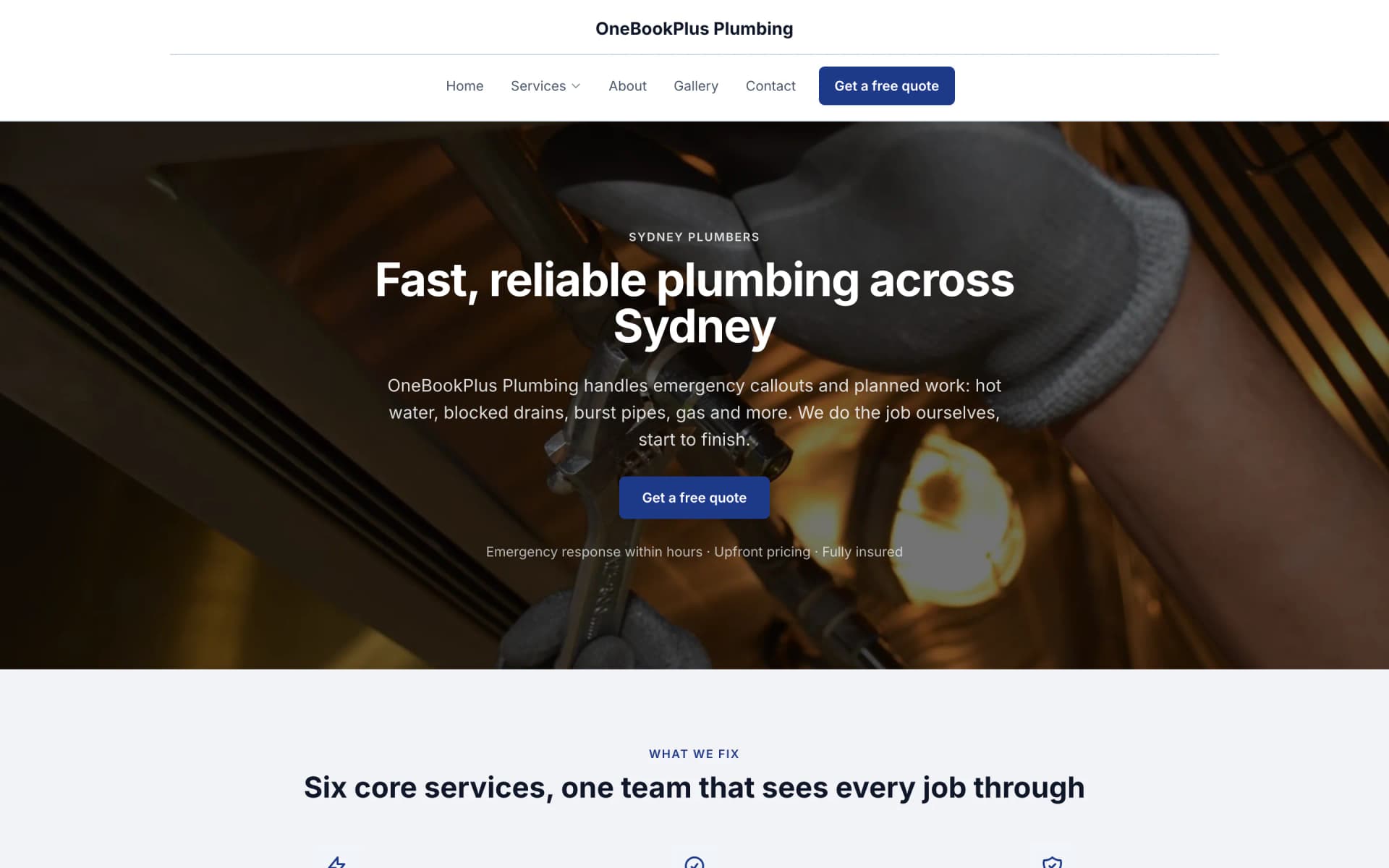
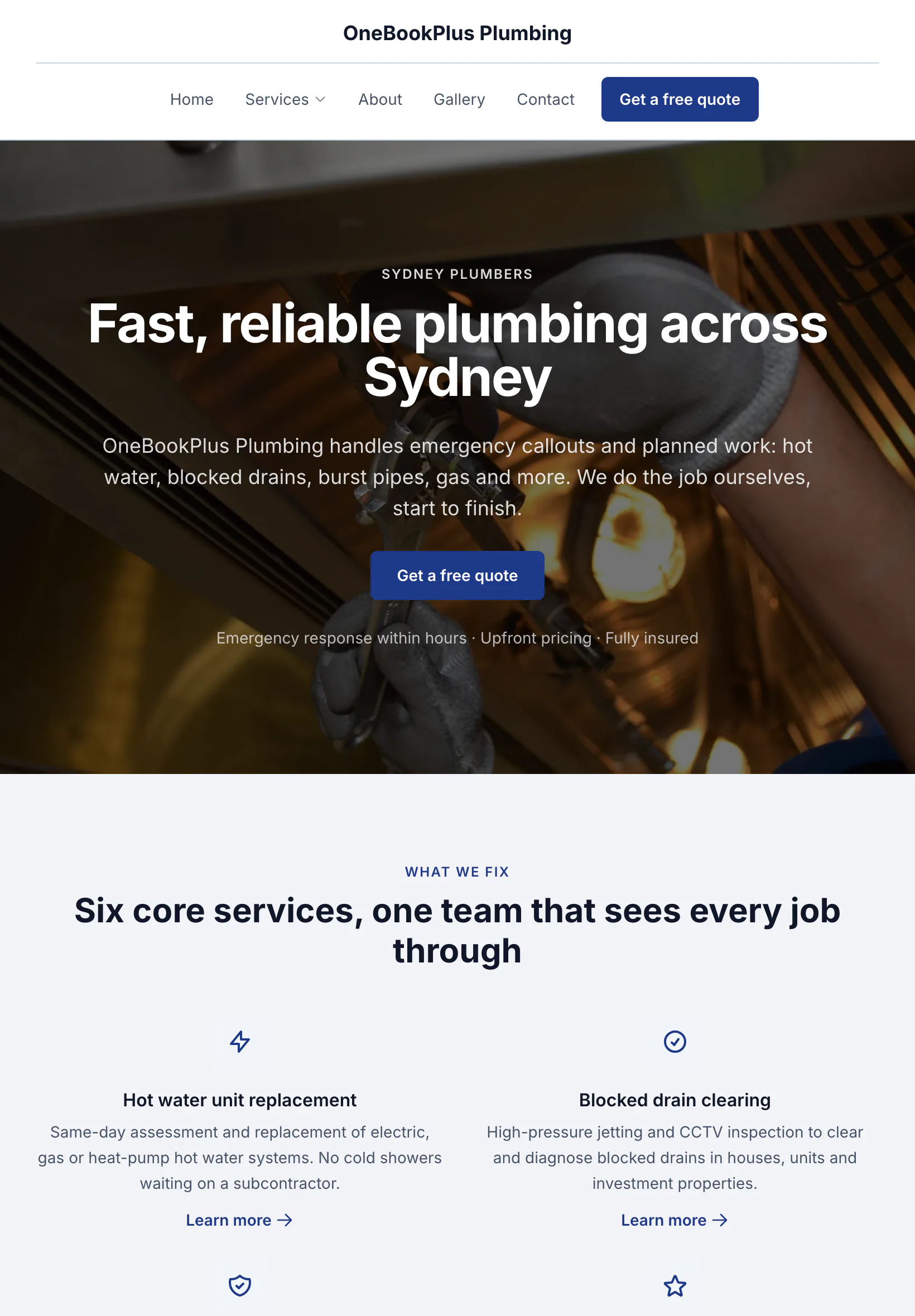
The home page: the name centred over the menu, a dark hero photo, a navy quote button and a grid of services.
Open the OneBookPlus Plumbing site(opens in a new tab)Built for Australian Builders
Send the frame-stage progress claim before you leave the slab.
Quote the build in stages, lock variations with one-tap client approval, track every subbie's payment, and claim each milestone, slab, frame, lock-up, fix, completion. Core from $0 to $69/mo, plus the optional Builder Suite estimating add-on at $99/mo, replaces Buildxact + Xero + Dropbox.
Free plan. No card required. · GST & ABN built-in · Progress claims with retention · Sign up in 60 seconds
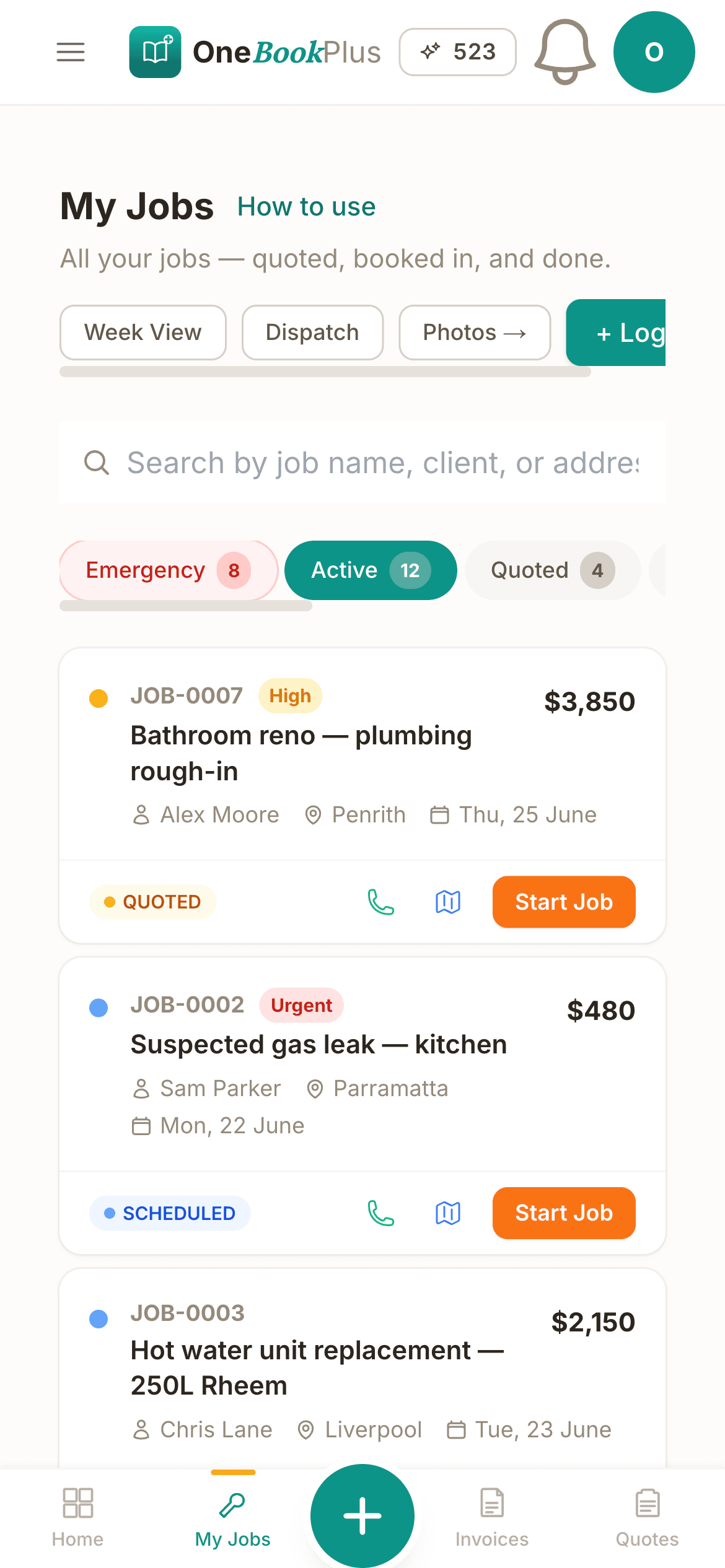
Xero, ServiceM8 and Squarespace add up to $90/mo at their own published starting prices, verified 2 August 2026. OneBookPlus Starter is $29/mo, a $61/mo difference, before whatever you pay for bookings, CRM and email marketing. Check the maths with your own numbers below.
See your savingsFree Tools & Resources
8-step founder guide, ABN, GST, licence, White Card, insurance, tools, pricing, first clients.
InteractiveInteractive estimator combining hourly rate, materials markup, travel, callout, and GST.
ReferenceState-by-state thresholds, regulators, and invoice requirements for AU trade licensing.
Operator GuidePlain-English MA000020, CW/1 to CW/10, industry/tool/fares allowances, RDO system.
ReferencePL, workers comp, tools, vehicle, PI, home warranty, contract works, coverage and premium ranges.
Key takeaways
5Everything You Need
Forget clunky desktop software. OneBookPlus is the builder business app designed for tradies managing projects, not sitting behind a desk filling in spreadsheets.
Build detailed project quotes with staged costings, foundations, framing, fit-out, finishing. Itemise labour, materials, and subcontractor costs so the client sees exactly where the money goes.
Invoice clients at each project milestone, slab, frame, lock-up, fix, completion. Track what's been billed vs. what's outstanding so cash flow stays healthy across long builds.
Track subbies assigned to each project stage. Log their quotes, invoices, and payment status in one place. Know exactly who's been paid and who's outstanding at any point in the build.
Client wants to upgrade the benchtops? Log variations with costs, get approval, and add them to the project total. Full audit trail of every scope change and its impact on the bottom line.
Capture progress photos on-site and attach them to the project record. Document each stage for clients, councils, and your own records, timestamped and organised by build phase.
Every invoice automatically calculates 10% GST and displays your ABN and builder licence number. Export GST summaries at BAS time, your accountant will thank you.
See real-time margin on every build. Compare quoted costs vs. actuals across labour, materials, and subcontractors. Spot budget blowouts early, before they eat your profit.
Log timber, concrete, fixings, and supply runs against each project. Snap receipt photos on-site so you know exactly how profitable every build really is after all costs.
Describe a job in plain words, or speak it, and watch a full, sectioned estimate build in front of you, priced from your own cost catalogue and calibrated to what you actually pay your suppliers. A built-in reviewer flags missing items, pricing outliers and AU compliance gaps, and lets you add any it finds to the estimate with one tap. You review every line; the AI just does the first draft. Included in the Builder Suite add-on at no extra charge, with no separate AI subscription and no per-estimate credits.
Learn more about AI EstimatingKeep your materials, labour and supplier rates in one catalogue, then build reusable recipes (assemblies) that price a stud wall or a slab per m² in one click. Every estimate stays grounded in your real costs and your markup, with wastage and PC/PS allowances built in.
Learn more about Cost Catalogue & RecipesUpload a plan (PDF or photo) and AI measures it, room areas, wall runs and counts, dropping each measurement straight onto the drawing with a confidence score. Zoom, pan and drag any shape to correct it, then tap one symbol (a power point, a downlight) and it finds and tallies every other one. Accept the numbers you trust and build a priced estimate from them.
Learn more about Digital plan takeoffPhotograph what's done on site and AI reads the photos against your schedule of values, suggesting a percent complete for each stage, frame at 90%, roof at 100%. It drafts the claim for you to review; you check every stage and nothing bills until you send it. The claim goes out as a GST-compliant invoice the client can pay online.
Learn more about Site photos into a progress claimFree plan available · No credit card · Cancel anytime
Website included
Every paid plan includes a full website, hosted by us, with nothing extra to buy and no separate builder: your site, its booking page and the tools behind them sit on one plan. The Free plan keeps the booking page and does not have the website.
The AI drafts every page from your own answers about your building work, not from your business name, and it does not invent claims. Every page is laid out for a phone as well as a desk. In the Website Studio you edit any section in place, add text, lists and buttons inside it, choose how many cards sit across, and change the look, which keeps your words, your photos and the spacing you set. The booking page is built in and the site's Book buttons go to it. Your first AI build is included with the plan. A later rebuild runs on AI Companion credits, and one that starts fresh replaces your pages, saving a restore point in History first.
Customers book building work from your site at any hour, and each booking lands in your dashboard ready to schedule.
Bathroom rough-in $3,850. Deck repair $1,200. A customer sees the price before they book.
The AI writes your services and the area you cover from your answers, so when someone searches 'builder in [suburb]' there is a page that says what you do and where.
No card needed to start.
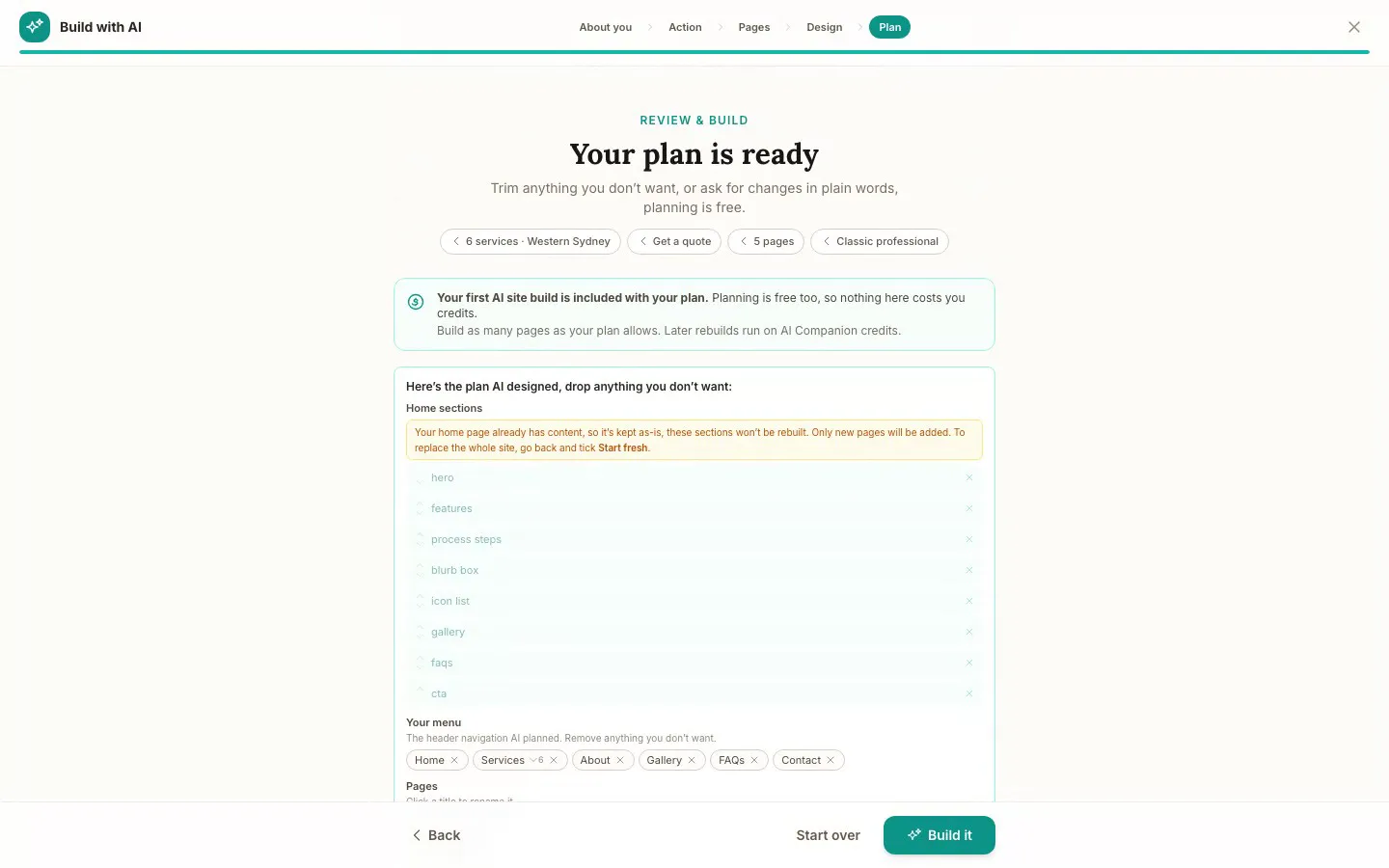
The Website Studio's Build with AI at its Plan step, on our plumbing demo: the pages, sections and menu the AI proposed from the answers already on the account, before anything is built. Click it to see it full size, or watch the recording of the build on the homepage.
Free
$0
A branded booking page on your OneBookPlus address. No website on this plan.
Starter
$29/mo
A website on your OneBookPlus address, hosted with SSL: 10 pages and a blog. The first AI draft is included.
Plus
$49/mo
Your own domain with SSL, 50 pages and a members area.
Growth
$69/mo
Unlimited pages, and a landing page per suburb from one template.
Your own domain connects on an active paid Plus or Growth subscription, not during the 14 day trial; a trial site lives on your OneBookPlus address. Every published site carries a small “Made with OneBookPlus” credit.
All three sites were drafted by the AI from the owner's answers, our own site included. It picks one of eight heading and body type pairings and how the cards sit (a fine line, a bold outline, a soft lift or no card), so a plumber's site, a driving school's and ours do not come out alike. Switch the view to see each one on a desktop, a tablet and a phone, click any screenshot to see it full size, or open the live site in a new tab. The plumber and the driving school are our demo businesses, not customers.
A plumber in Sydney
The home page: the name centred over the menu, a dark hero photo, a navy quote button and a grid of services.
Open the OneBookPlus Plumbing site(opens in a new tab)



A driving school in Donnybrook
The home page: a teal logo and name on the left, an L plates hero and lessons and packages as cards.
Open the OneBookPlus Driving School site(opens in a new tab)



Our own site, built the same way
The home page: a serif heading beside a framed photo on pale grey, and no full width hero at all.
Open the OneBookPlus site(opens in a new tab)See it in action
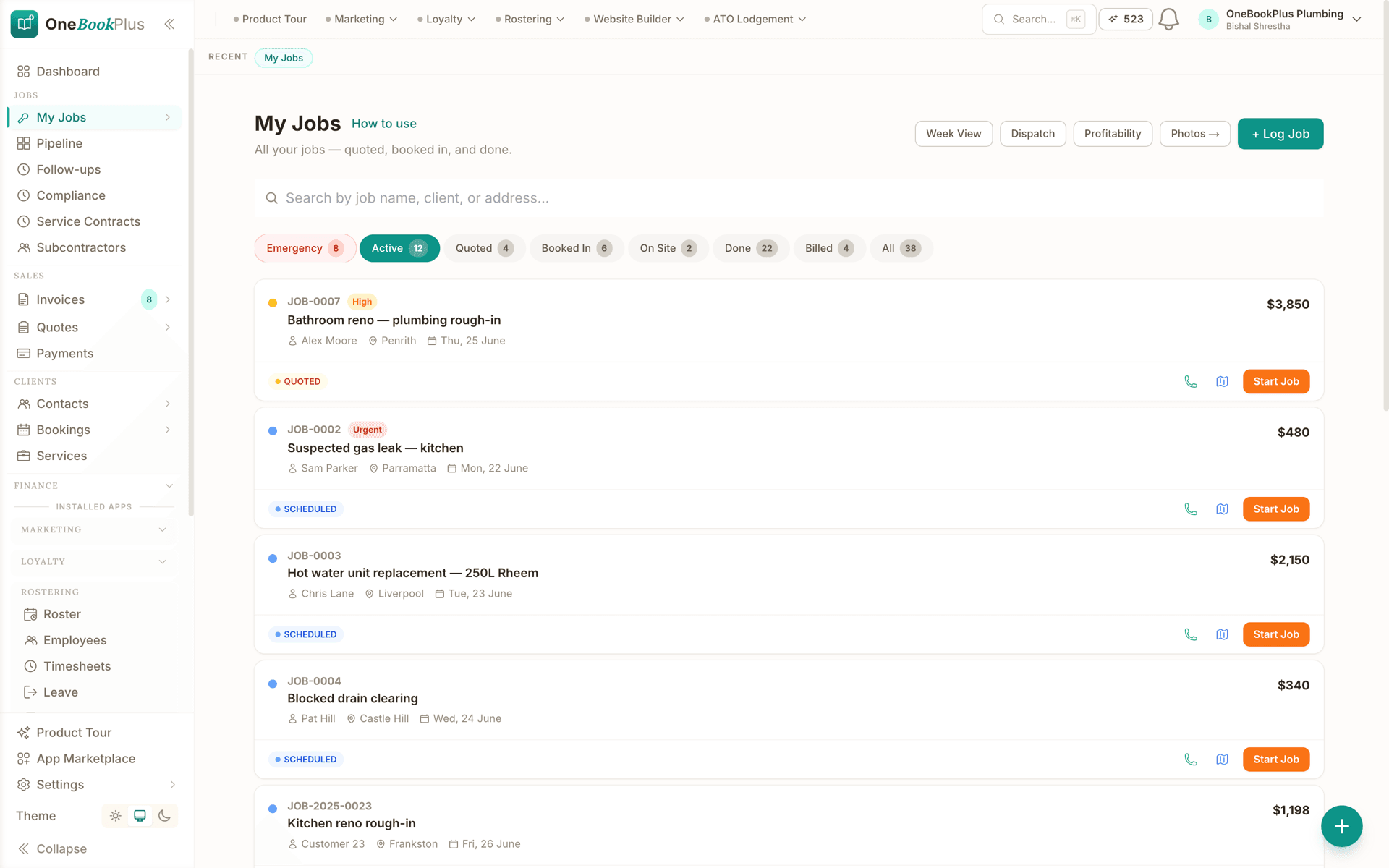
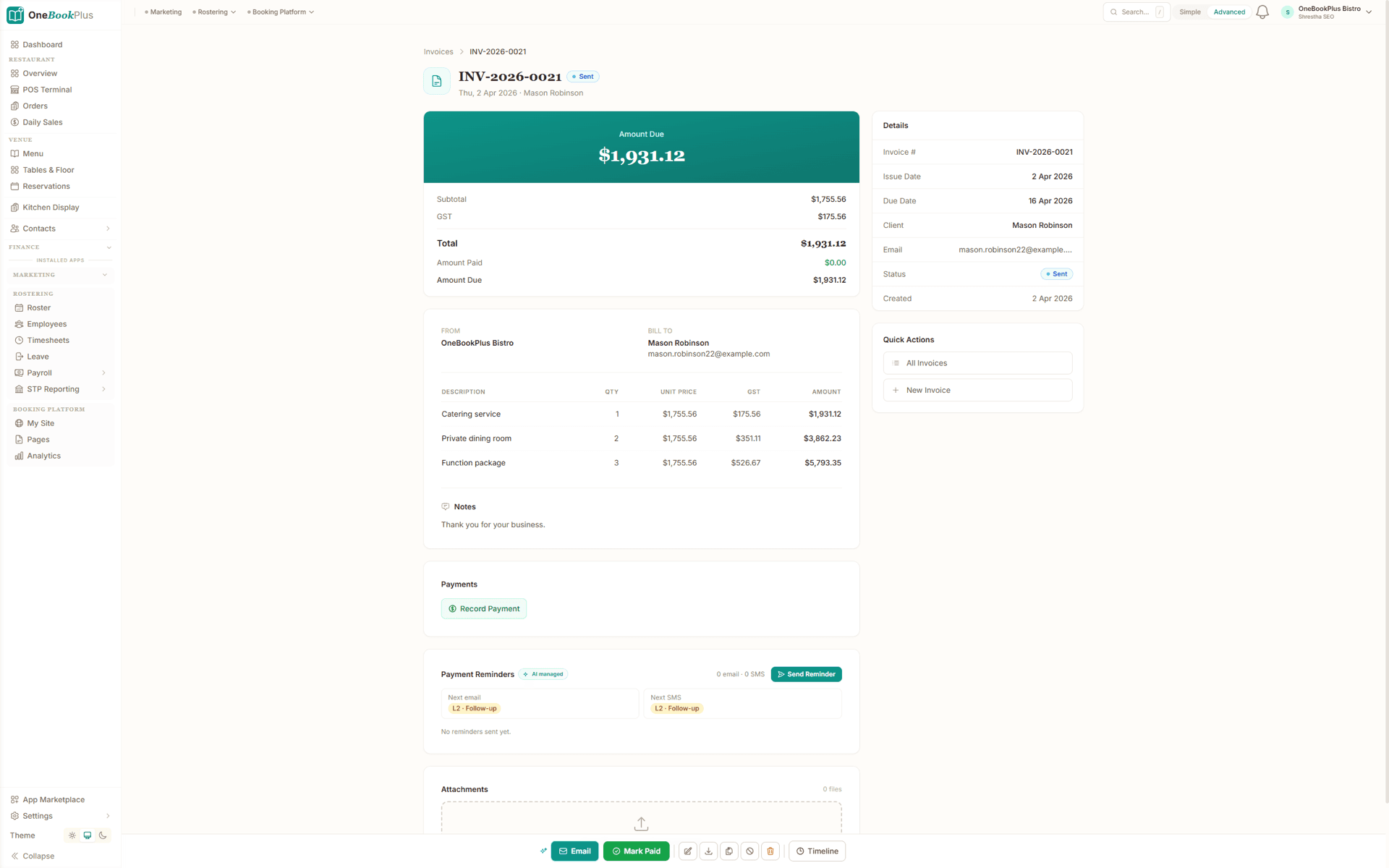
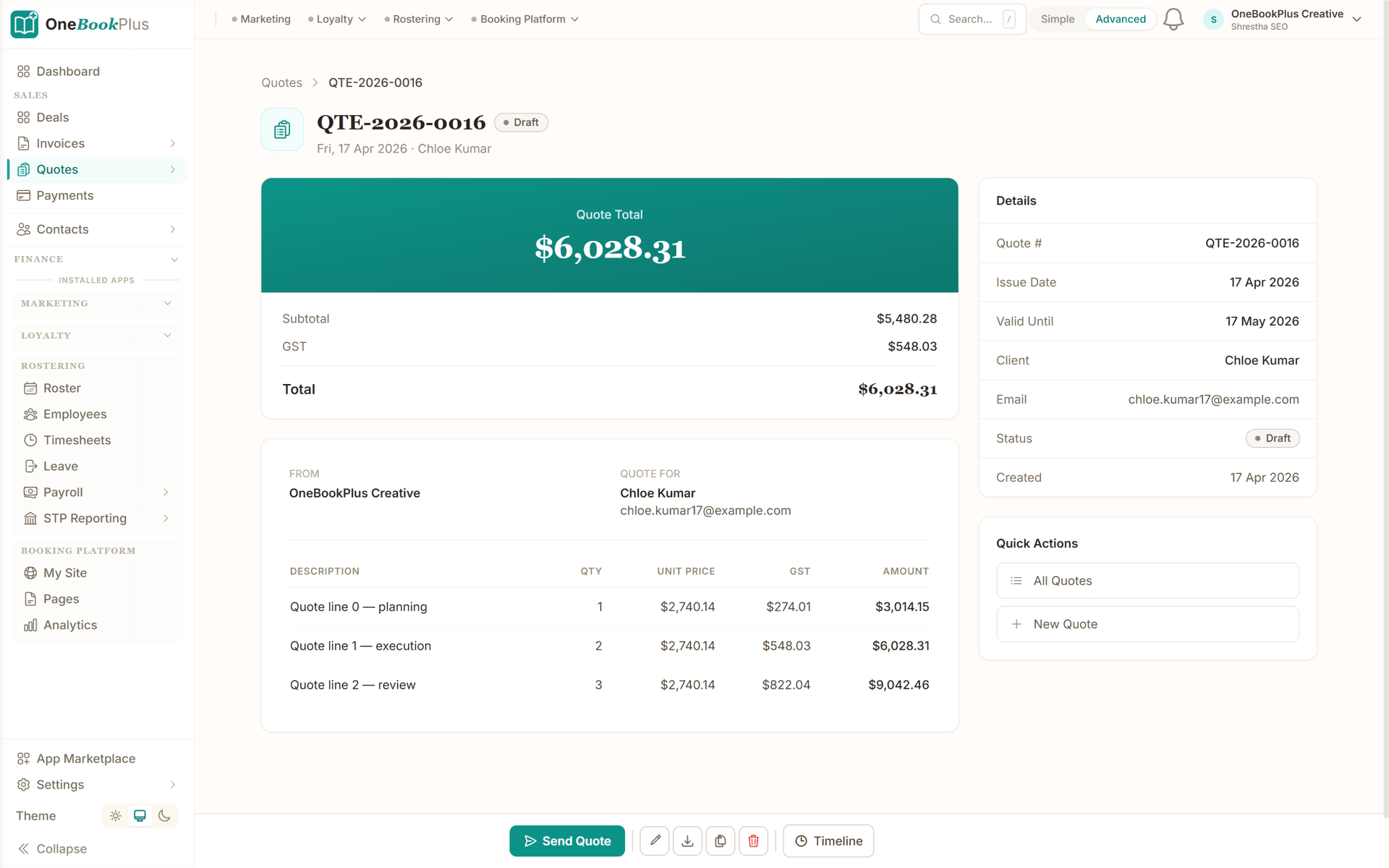
These are real product screens: the project pipeline board, the progress-claim invoice, and the quote that becomes the contract. Tap any screen to zoom in.
Every build stage across every active project: contract signed, slab down, frame up, lockup, practical completion.
Stage invoicing with line items, GST, retention, balance due. Stripe or direct-debit the deposit.
A OneBookPlus quote: fixed-price or cost-plus with line items. The client accepts online and the quote becomes the paper trail for the build.
The app
Builder Suite is the estimating and cost-control layer that sits on top of your core OneBookPlus plan.
Estimating to progress claims, on one platform
Builder Suite turns OneBookPlus into a complete build-management platform for custom-home builders, renovators and small commercial builders. Estimate from a reusable cost catalog of labour, materials, subbies and allowances, and assemble whole scopes in seconds with recipes, save a bathroom, a slab or a framing package once and drop it into every quote. Upload the plans and let AI plan takeoff measure areas, counts and lengths for you, or use scan-to-plan in the OneBookPlus iOS app on a LiDAR device, an iPhone Pro or iPad Pro, to capture a room on site. Turn a winning estimate into a fixed-price quote, then run the whole job: raise progress claims against a schedule of works with retention withheld automatically at your contract percentage and shown on its own line on the tax invoice, price and track variations so nothing goes un-billed, and issue RFQs to your subbies and suppliers to lock in real prices. The running total of retention held sits on the claims screen, and you claim it back at the release milestone the same way you raise any other claim. Cost control runs live against your budget, committed costs, actuals and forecast in one view, with overrun alerts the moment a cost code trends over. Keep a dated site diary with photos, weather and who was on site, and log and close out defects at handover. Every quote, claim, variation and invoice flows into the same OneBookPlus contacts, invoicing and accounting you already use, no double-entry, no separate logins. Builder Suite is a $99/mo add-on on top of any core plan (Free, Starter, Plus or Growth), includes AI with fair-use, is one price for the whole business with no per-seat fee for the app itself, and starts with a 14-day free trial. Logins are set by your core plan, 1 on Free, 3 on Starter, 5 on Plus and 10 on Growth, with extra logins on Growth at $9 each a month, and staff you only put on the roster, who never sign in, are free on every plan.
Simple Workflow
From project quote to final payment in four steps, designed around how builders actually manage builds.
Estimate from your own cost catalogue and reusable recipes: or let AI draft the estimate from a plain description or a plan you upload: then turn it into a staged project quote broken down by phase: foundations, framing, fit-out, completion. Labour, materials and subcontractor costs with GST calculated automatically, sent as a professional PDF with your ABN and builder licence.
Schedule project phases, assign subbies, track progress with site photos, and log variations as they come up. Every change is documented with costs and client approval.
Send progress claims at each stage: slab, frame, lock-up, fix, completion. Convert quoted stages to GST-compliant invoices with one tap.
Customers pay online via the invoice link. Automated reminders chase overdue progress payments so you can keep the build moving, not chase money.
Free plan, no card required, and your staged quote is ready to send today
Who it's for
Whether you're a sole trader doing renos or running a crew on new builds, OneBookPlus adapts to how builders work.
Managing new home builds and renovations. Needs staged project quoting, progress billing at each milestone, and variation tracking when clients change their minds.
Larger projects with multiple subcontractors and staged payments. Needs subcontractor management, progress claims, and real-time project profitability tracking.
Kitchen, bathroom, and extension projects. Needs detailed quoting with materials breakdown, site photos for client updates, and fast invoicing on completion.
Managing subbies and suppliers on behalf of owner-builders. Needs clear cost tracking, subcontractor scheduling, and transparent client-facing invoices.
Named tools, at each vendor’s own cheapest published plan, and ours underneath. Vendor pricing changes, so check each one before you decide.
Or use OneBookPlus
$128/mo
Everything in the list above, on one bill.
Start freeNo credit card · Free forever · Cancel anytime
Example walkthrough
An illustrative walkthrough of a typical building day
You start the week reviewing the project dashboard: two active builds and a renovation. One build is at frame stage with the progress claim due, and the renovation has a variation request from the client for upgraded kitchen benchtops.
You log the variation in OneBookPlus, stone benchtops instead of laminate, and send the variation approval to the client with one tap. They approve by lunchtime.
On site, you snap progress photos of the completed framing, attach them to the project, and send the frame-stage progress claim including GST. The invoice goes out as a professional PDF with your ABN and builder licence number.
You check the subcontractor tab: the plumber and the electrician have both invoiced for rough-in. You mark the plumber as paid and queue the sparky's payment for Friday.
End of day: one progress claim sent, one variation approved, subbie payments tracked. The profitability dashboard shows the build tracking against its estimated margin, and come BAS time the GST summary exports in one click.
How we compare
See how we compare to the tools builders typically use.
| Feature | OneBookPlus | Xero | Buildxact | CoConstruct |
|---|---|---|---|---|
| GST invoicing | Yes | Yes | Yes | Yes |
| Staged project quotes | Yes | No | Yes | Yes |
| Progress billing | Yes | No | Yes | Yes |
| Variation tracking with approval | Yes | No | Yes | Yes |
| Subcontractor management | Yes | No | Yes | Yes |
| Site photos & documentation | Yes | No | No | Yes |
| CRM & client history | Yes | No | No | No |
| Expense tracking with photos | Yes | Yes | Yes | Yes |
| BAS-ready tax reports | Yes | Yes | No | No |
| Free plan available | Yes | No | No | No |
| Price | From $0/mo | $37+/mo | $199+/mo | Subscription |
1 tap
Convert an accepted quote to a GST invoice
$0
Free plan, no monthly fees to get started
$29/mo
Starter plan, unlimited invoices and quotes
100%
GST & BAS compliant for Australian builders
Builder savings calculator
Adjust the numbers below to match your real monthly spend. The total updates live, and so does what you'd save by replacing the lot with OneBookPlus.
Accounting (Xero, MYOB, QuickBooks)
Xero's cheapest published plan
Jobs & quotes (Buildxact, Buildertrend, simPRO)
ServiceM8's cheapest published plan
Website + hosting (Squarespace, Wix)
Squarespace's cheapest published plan, billed monthly
Bookings (Calendly, Acuity)
Calendly publishes US$10/mo. Type what you pay in Australian dollars.
CRM (HubSpot, Pipedrive)
HubSpot publishes US$20/mo. Type what you pay in Australian dollars.
Email marketing (Mailchimp, Klaviyo)
Mailchimp publishes no ongoing price. Type what you pay.
Rows open at the cheapest plan Xero, ServiceM8 and Squarespace publish, verified 2 August 2026. Calendly and HubSpot publish in US dollars and Mailchimp publishes no ongoing rate, so those three rows open at zero for you to fill in rather than carry a converted figure.
Your current stack
$90/mo
= $1,080/year
With OneBookPlus Starter
$29/mo
Replaces everything in the list. One bill.
Free plan available · No card required · Cancel anytime
An illustrated day, not real customer data. Scroll through it from morning to 5pm: the AI receptionist answers and books a missed call, the work runs from the app, the GST invoice is sent on the spot, payment lands and the books balance themselves, a review invite is queued for the next daily run, and the day closes with the ledger already written.
6:50am
While you're loading the ute
A Palm Beach couple want their bathroom renovated. They call the first builder on Google, you.
AI Receptionist
The AI answers in two rings, books a Thursday site visit and texts a confirmation, before you've left the driveway.
On site
Job card on your phone: address, scope, the approved quote. Variations log with one tap if the frame's worse.
From the ute
Deck done by midday. One tap converts the job to a GST invoice with a pay link. No evening paperwork.
While you're at the next site
Card payment lands, the books update themselves, and $109.09 GST is set aside for BAS.
Reputation on autopilot
After payment clears, the AI texts Rob an invite to leave a review, timed to the delay you set. No chasing, no awkward ask.
The day closes itself
One job done, one quote booked, subbies tracked. The book did the rest.
$0
collected
0
admin tasks done by AI
0
evenings lost
An illustrated day, not real customer data. AI Receptionist is a $79/mo add-on that needs AI Companion ($25/mo, included on Growth), and AI Companion is what sends the review invite as well. The rest of the day is the app itself.
Builder pricing
Start free, upgrade when the contracts justify it. No contracts, no setup fees, no per-project tax. Cancel any time.
Free
$0/forever
Quote your first reno today, no credit card.
Starter
$29/mo
Replaces Buildxact + Xero + Dropbox for site photos.
No card · Drops to Free if you don't upgrade
Plus
$49/mo
Outgrowing the basics, advanced reporting.
Our pick: unlimited contacts and booking pages for $49
Growth
$69/mo
For commercial builders juggling subbies, claims and marketing.
Builder Suite
$99/mo
Add full estimating and cost control on top of any core plan: a cost catalog and recipes, AI plan takeoff, room scanning on a LiDAR iPhone or iPad, progress claims with retention, variations, RFQs, a site diary and defects. No per-seat fee for the app itself, and AI included with fair-use.
Added on top of your core plan
Prices in AUD inc. GST. Online card payments carry Stripe processing fees (1.7% + 30¢ AU cards) plus a 2.5% OneBookPlus platform fee. See the full plan comparison
Already on another tool?
Switching is designed to fit in a single evening. Export your clients, subcontractors and active jobs as CSV from your current tool, import them into OneBookPlus with the bulk importer, and you're sending progress claims before the concrete truck arrives tomorrow.
Switch from
Built-in AI
You're under a sink or up a ladder, you can't stop the job to grab the phone, and every missed call is work that goes to the next tradie on Google.
OneBookPlus
AI Receptionist · incoming call
“Burst pipe in the laundry, can someone come today?”
If you don't answer, the AI books it, Emergency call-out · today 2:00pm, and texts a confirmation.
Extend Your Toolkit
Add advertising, tax lodgement, project tools, and more to grow your building business.
Built in Melbourne, AU
ATO-ready from day one
TLS in transit, AES-256 at rest, tenant isolation at the database layer, read the security page
No credit card needed
Common questions about invoicing and project management software for builders in Australia.
The best accounting software for an Australian builder ties GST-ready bookkeeping to the way builds actually invoice, progress claims at slab, frame, lock-up, fix and completion, plus variations and subcontractor payments. Xero and MYOB are the standard accounting packages but don't model progress billing or job costing on their own, so builders bolt on a separate estimating or job-management tool. OneBookPlus combines progress-claim invoicing, variation tracking, subcontractor management, job-level cost tracking and BAS-ready accounting in one platform from $0/month, fewer tools to reconcile at month's end.
Yes, for residential and small-commercial builders, OneBookPlus is a practical simPRO or AroFlo alternative. simPRO and AroFlo are powerful for large contracting firms with deep inventory and project-accounting needs, and we don't claim to match that enterprise depth. OneBookPlus is aimed at builders who want progress billing, variations, subcontractor tracking, site photos and GST invoicing in one affordable subscription that starts free, without enterprise onboarding, and with a banded number of logins included in the plan price rather than an open-ended per-seat quote.
Yes, our free plan includes 10 invoices and 5 quotes a month and up to 250 contacts. Great for sole trader builders or small residential builders getting started. Upgrade to Starter ($29/mo) for unlimited invoices and quotes as your building business grows.
Every progress claim automatically calculates 10% GST, displays your ABN and builder licence number, and meets ATO requirements. Invoice at each project milestone, slab, frame, lock-up, fix, completion. At BAS time, export a GST summary in one click.
Yes. Log variations with costs, get client approval, and add them to the project total. Every variation includes a full audit trail, what changed, when, who approved it, and how it affects the project price.
Absolutely. Track subbies assigned to each project stage, log their quotes and invoices, and monitor payment status. You always know who's been paid and who's outstanding across every active build.
Yes. Take progress photos on-site and attach them directly to the project record. Photos are timestamped and organised by build phase, perfect for client updates, council inspections, and your own records.
Yes. Store your state home warranty insurance certificate against each contract, NSW HBCF (via icare) for residential work over $20,000, VIC Domestic Building Insurance for work over $16,000, QLD QBCC Home Warranty Scheme for work over $3,300, and equivalents in SA, WA and TAS. Attach NCC Volume 1 (Class 2 to 9) or Volume 2 (Class 1 & 10) compliance notes, NatHERS energy ratings (7-star minimum under NCC 2022), and engineer-stamped certificates for AS 1684 timber framing, AS 3600 concrete, AS 3700 masonry, AS 4100 steel and AS 1170 wind/structural loads, all linked to the job for council, certifier and insurer access.
Yes. Build estimates from a cost catalogue and reusable recipes (assemblies), with markup or margin, wastage and PC/PS allowances, then convert an accepted estimate straight into a contract job that bills by progress claim. You can also upload a plan and have AI read the measured quantities off it into a review queue you check line by line. Unlike Buildxact, the estimating, invoicing, online payments and GST accounting all live in the one platform, clients can pay a progress claim online, and it's not a separate tool to reconcile.
Yes, and the AI costs nothing extra: it is included in the Builder Suite add-on rather than sold as a separate AI subscription or metered per-estimate credits. Describe a job in plain words (or speak it) and a full sectioned estimate streams in, priced from your own cost catalogue and calibrated to what you actually pay your suppliers. Or upload a plan (PDF or photo) and AI measures the room areas, wall lengths and counts off it, drawing each one onto the plan with a confidence score, you can zoom, pan and drag any measurement to correct it, and tap a single symbol to have it find and count every other one. A separate AI reviewer checks a drafted estimate for missing items, pricing outliers and Australian compliance gaps, termite management to AS 3660, waterproofing to AS 3740, smoke alarms, NCC energy efficiency, and lets you add anything it finds with one tap. You review and adjust every line before anything is sent; the AI does the first draft, you make the call.
Yes. Photograph the work as it progresses and AI reads the photos against your job's schedule of values, suggesting a percent complete for each stage, frame, roof, lock-up, with a short reason for each. It drafts the claim; you review and adjust every stage, and nothing is billed until you send it. The claim materialises as a GST-compliant progress-claim invoice (with retention withheld if you use it) that your client can pay online.
Buildxact is a capable estimating and job-management tool, but it has no built-in payment collection, a tax-exclusive-only engine, and its AI estimating is a paid add-on. OneBookPlus builds the estimating, AI plan takeoff, progress claims with retention, variations, subcontractor tracking and GST-ready accounting into one platform, with the AI included in the plan price and clients able to pay progress claims online. A few things Buildxact can't do: tap one symbol on a plan and have AI find and count every other one (their counting is click-by-click), turn site photos into a drafted progress claim, and calibrate estimate pricing to your own recent supplier costs. You can export your data any time, so there's no lock-in.
Yes. When your contract lets the client withhold retention (commonly 5% of each claim during construction), OneBookPlus withholds it on the claim automatically at the percentage you set and keeps a running retention balance per contract, so the total held is on the claims screen and never gets lost. Claiming it back at the release milestone is a claim you raise yourself, the same way as any other: there is no one-tap retention release yet. Retention tracking comes with the Builder Suite app, $99/mo on top of any core plan including Free, not with the Growth plan, so retention money stops disappearing into part-paid invoices you forget to chase.
For most residential and small-commercial builders, no: the ledger, GST on claims and materials, profit and loss and the BAS summary are part of the same system your jobs, claims and variations live on. The practical question is usually your accountant, not the software. They keep working the way they already do: give them their own read-only login to the books, or export the chart of accounts, journals, contacts and transactions to CSV whenever they ask for them. If they insist on running their own ledger you can leave them to it and use OneBookPlus for the jobs, claims and variations, but you are back to reconciling two systems, which is the thing this was meant to stop.
Three things generic packages don't model: progress claims (revenue arrives in stages tied to construction milestones, with GST payable as each claim is issued), retentions (money the client withholds that isn't overdue, just not yet due), and job costing (knowing whether an individual build made money, not just the business overall). OneBookPlus handles all three natively: claims come off the contract's schedule of values, retention is withheld on every claim at your contract percentage with the running balance held shown on the claims screen, and every expense and subbie invoice is recorded against its job so quoted-versus-actual margin is live per build.
Buildxact starts at $199/mo and Xero at $37/mo (both AUD, per their published pricing, and both figures read from our competitor registry rather than typed here), so $236/mo before you add photo storage or a CRM, and the two lines are not on one GST basis: Buildxact publishes ex GST, Xero includes it. OneBookPlus core plans run $0 (Free), $29 (Starter), $49 (Plus) or $69 (Growth) per month, and the optional Builder Suite estimating and cost-control add-on is $99/mo on top of any core plan, with no per-seat charge for the app itself. Each plan includes a set number of logins: 1 on Free, 3 on Starter, 5 on Plus and 10 on Growth. On Growth an extra login is $9/mo, prorated onto the same invoice, so an eleventh hire costs $9 and not a new plan. Rostered staff who never sign in (instructors, cleaners, stylists) are free and unlimited on every plan. A builder who needs full estimating, AI plan takeoff, progress claims with retention and accounting pays $99 to $168 a month all-in, one login, one set of numbers.
For most residential and small-commercial builders, yes, and this is the structural difference rather than a feature you tick off a list. The frame-stage claim, the bricklayer's invoice and the timber merchant's bill all post to the same double-entry ledger that produces the profit and loss, balance sheet, cash flow and BAS summary, so the claims register and the books cannot drift apart: there is nothing to sync because there is only one set of records. That ledger and the BAS report are on every plan, including Free: we do not charge for compliance. One boundary worth stating plainly: the BAS figures are prepared for you, BAS-ready, and you lodge them yourself. Most job-management tools in this trade stop before the ledger. Tradify has no built-in accounting and requires Xero or MYOB; ServiceM8 has no built-in accounting and requires Xero; AroFlo requires Xero or MYOB for accounting; simPRO still requires Xero or MYOB for accounting. Buildxact's own recorded weak points are accounting-sync friction with Xero, MYOB and QuickBooks Online, and no built-in payment collection at all.
Both, and you choose per contract rather than per subscription. On a staged contract the accepted estimate becomes the schedule of values, so you claim a completed stage, slab, frame, lock-up, fixing, completion, or a percentage complete against any individual line. Claimed-to-date is tracked against the contract so a claim can never quietly overshoot it, approved variations lift the contract value before you claim them, and retention is withheld at your percentage with the running balance held shown on the claims screen, ready for you to claim back yourself when it falls due. The claim goes out as a GST-compliant tax invoice showing this-claim and to-date totals with an online payment link. On a cost-plus job you invoice from received purchase orders and supplier bills with your markup applied instead. One thing we are careful about: these are progress-claim tax invoices, not statutory payment claims under the Security of Payment legislation in each state, which is a separate legal instrument with its own wording and service rules. Progress claims and retention are part of the Builder Suite app, $99/mo on top of any core plan.
Everything sits on one drag-and-drop job calendar with month, week and day views down to 15-minute precision and colour-coded statuses, so Tuesday's slab pour and Thursday's frame inspection are on the same screen as the two other builds still running. The dispatch board gives every team member their own column plus an unassigned lane for work nobody has picked up yet, conflict detection stops you booking the same chippy in two places, recurring schedules cover standing site visits, and daily run sheets go out for the morning. Build stages sit on that calendar with crews and subbies assigned to them. What it does not do is a Gantt chart with task dependencies and a critical path, so if you need a linked programme where slipping the slab automatically pushes every downstream trade, that is not this. Invoicing several jobs in one batch is a Plus $49/mo feature.
Yes. Supplier bills and materials purchases are coded to the job, so the timber merchant's invoice, the concrete order and the crane hire land against the build that consumed them, and the GST credits flow into the BAS summary. The Receipt Inbox takes receipts by email into a staging queue with OCR-suggested fields ready for one-click expense creation, and you can drag a supplier PDF or a photo of a docket straight in and have the supplier, date, GST and total read off it for you to check. The job-coded bills and the GST credits that flow into the BAS summary are on every plan, including Free, and the Receipt Inbox is included from Starter at $29/mo. Where it stops, honestly: there is accounting-grade inventory with on-hand quantities, low-stock alerts and stock-take, but no van-stock or multi-warehouse module, and no automatic supplier-account sync, so trade-account statements from your merchants still arrive as bills to record rather than syncing themselves. There is no live bank feed at the moment either, so bank transactions are entered or imported rather than arriving on their own.
About the author

Founder & CEO, OneBookPlus
Bishal spent a decade running digital projects for Australian small businesses before founding OneBookPlus. He writes and maintains these pages, and publishes what OneBookPlus does not do alongside what it does.
Read the founder bioHow this page was researched
The compliance and licensing statements above are taken from the bodies this page links to, including the HIA, the National Construction Code and icare NSW, so you can read the rule rather than take our word for it. Plan prices come from the OneBookPlus price registry, so the page and the checkout cannot disagree. Everything said about OneBookPlus describes what the product does today, and the page says so where it does not do something.
Building businesses run on razor-thin margins, and most of the admin stack works against you. You're estimating jobs in Buildxact or Excel, managing subbies with phone calls and texts, invoicing progress claims through Xero, and tracking site photos in Dropbox or a camera roll that's three phones old. Throw in Tradify or Deputy for scheduling and you are paying four or five bills a month for one workflow, none of which give you a single view of how a project is actually tracking against budget. By the time you realise a build has blown its margin, it's too late to claw it back.
OneBookPlus puts your entire building business in one place. Create staged project quotes with costs broken down by phase: foundations, framing, lock-up, fit-out, completion. Track subcontractor assignments, quotes, and payments per stage. Log variations with client approval and see the impact on your project total in real time. Send progress claims at each milestone as GST-compliant invoices with your ABN and builder licence number. Capture site photos on your phone and attach them directly to the project record, timestamped and organised by build phase. And because invoicing and accounting live in the same system, your profitability dashboard shows real margin, quoted vs. actual, across labour, materials, and subbies at any point in the build.
Monday morning. You open OneBookPlus and review your project dashboard: two active new builds and a kitchen renovation. The Brookvale build is at frame stage with the progress claim due this week. The Dee Why reno has a variation request: the client wants stone benchtops instead of laminate. You log the variation ($4,200 uplift), send the approval request with one tap, and the client confirms by lunchtime. At the Brookvale site, you snap progress photos of the completed framing, attach them to the project, and send the frame-stage progress claim of $92,000 including GST. You check the subcontractor tab: the plumber and electrician have both invoiced for rough-in. You mark the plumber as paid and schedule the sparky's payment for Friday. End of day: one progress claim sent, one variation approved, subbie payments tracked, and your profitability dashboard shows the Brookvale build tracking 3% above estimated margin.
When the Brookvale client pays their progress claim, you record the payment and it clears against the outstanding invoice, so the claims register and the ledger cannot drift apart. Subcontractor payments are reconciled against their logged invoices. Materials purchases from Bunnings, timber yards, and concrete suppliers are coded as project expenses, and you can drag in the supplier PDF or a photo of the docket and have the supplier, date, GST and total read off it for you to check before it posts. You can see exactly how much cash has flowed in and out of each project at any moment, not three months later when your accountant finishes the quarterly. BAS summaries generate in one click: GST collected on progress claims, GST credits on materials and subbie invoices, net amount owing.
Sign up free. No credit card, no lock-in contract. Select “Builder / Construction” as your business type and OneBookPlus pre-configures your account with staged project templates, common build phases, and invoice layouts that include your builder licence number. Import your client and subcontractor lists via CSV from Buildxact, Tradify, or a spreadsheet. Within your first week you'll have a project quoted with staged costings, your first progress claim sent, and supplier bills scanned in and coded to the job. The switch is designed to fit in a weekend: export the CSVs from your current tools, import them, and set your build stages.
Most accounting software was designed for businesses that sell something, invoice it once, and get paid. Building doesn't work like that. A residential build is invoiced five or six times across months, each claim tied to a construction stage, with GST payable as each claim is issued, not when the contract is signed. If your ledger can't see the build stages, you end up maintaining a spreadsheet on the side just to know what's been claimed, what's outstanding, and what the client still owes at handover. That spreadsheet is where errors live: a missed frame-stage claim on one job can sit unnoticed for weeks while you're paying subbies and buying materials out of your own pocket.
Retentions make it worse. Many building contracts let the client withhold a percentage of each progress claim (the rate comes from your contract, and only Queensland fixes percentages by statute, set out on the GST on progress claims guide) until the defects liability period ends. Generic accounting packages have no concept of retention: the withheld money shows up as a part-paid invoice or an overdue debtor, and a manual deduction leaves no running balance, so nobody can say what is held across the jobs and nobody diarises the release. OneBookPlus withholds retention on every progress claim at the percentage your contract sets, so the amount held on each claim and the running retention balance per contract are always visible. Claiming it back at the release milestone is a claim you raise yourself, like any other. Retention tracking comes with the Builder Suite estimating and cost-control app, which sits on top of any core plan including Free. It is not part of the Growth plan.
The third gap is job costing. Your accountant can tell you whether the business made money last quarter; they can't tell you whether the Burleigh build made money, because Xero or MYOB on their own don't tie timber invoices, subbie payments and labour to a specific job without add-ons and discipline. OneBookPlus records every expense, subcontractor invoice and progress claim against the job, so quoted-versus-actual margin is live for each build, and GST credits on materials and subbie invoices flow straight into your BAS summary. There's no separate reconciliation between a job-management tool and an accounting tool, because they're the same system: see the Finance features overview and the bookkeeping software page for how the ledger side works.
If you're currently running Buildxact for estimating and Xero for the books, that's two subscriptions, two logins, and a monthly ritual of matching claims in one system to invoices in the other. The OneBookPlus vs Buildxact comparison walks through the differences line by line, and the job management software guide covers the scheduling and job-tracking side. For the contract side on its own, how a build is tracked stage by stage from signed contract to final claim, see the construction project management software page. The short version: estimating, claims, payments and accounting in one place means one set of numbers, and they always agree with each other.
Two things sit inside that argument, because they are what builders actually go looking for. Accounting software for construction is not really its own category: it is ordinary double-entry accounting that also knows what a job is. And construction billing is the half generic packages get wrong, because a progress claim is not a sale, it is a draw against a contract value that moves every time a variation is approved. Accounting software for construction contractors has to hold both ideas at once, plus a TPAR at year end and GST falling due as each claim is issued rather than at completion, which is why building industry accounting software has to be built to Australian rules rather than translated into them afterwards.
A progress claim is just an invoice for the portion of the contract you've completed, but the mechanics matter. Standard HIA and MBA residential contracts break the price into staged payments: deposit, base or slab, frame, lock-up (enclosed), fixing, and practical completion. Each stage has an agreed value, and when the stage is done you issue a claim for that amount plus GST. In OneBookPlus, the accepted quote becomes the contract's schedule of values, so each claim starts from the agreed stage amounts rather than a number typed from memory.
When you raise a claim, the system shows what's been claimed to date, what remains on the contract, and any approved variations that adjust the total. Retention, if your contract uses it, is withheld automatically at the percentage you set, and the running balance held stays on the claims screen until you raise the claim to get it back. The claim goes out as a GST-compliant tax invoice showing your ABN and builder licence number, with an online payment link so the client can pay by card or bank transfer the moment they open it. Automated reminders chase overdue claims, which matters when the next stage's materials order depends on the last stage's payment.
Every claim, payment and retention movement lands in the same ledger as your expenses, so the claims register and your books can't drift apart. And because timely, well-documented claims are also what the Security of Payment legislation in each state expects, having the paper trail (claim dates, amounts, stage evidence and site photos) attached to the job protects you if a payment dispute ever escalates. For builders on the Builder Suite app, AI can even read your site photos against the schedule of values and draft the claim for you to review before anything is sent.
A build makes or loses its money in the gap between what you priced and what you actually spent. Everything below is about closing that gap, and about paying for the lot on one subscription.
Four records have to agree before a build is legible: the priced estimate you won the work on, the schedule of values you claim against, the cost actually incurred on that job as it runs, and the ledger your BAS comes out of. Most building industry software joins two of them and leaves you carrying the rest. An estimating package knows what you quoted, not what the concreter finally charged; an accounting package sees a $92,000 frame claim as revenue with no build attached to it.
In OneBookPlus the four are one system, not an estimating tool bolted onto an accounting tool with a sync between them. Job Costing sets labour and materials cost against billed revenue per build and colour-codes the margin. Project Budget vs Actual puts estimated hours, materials and totals beside the real ones and surfaces an overrun while the job is still running. Both read the same double-entry ledger that produces the BAS report (G1, 1A, 1B, G10, G11, W1, W2 and 5A, cash or accrual) and auto-detects the contractor payments that belong on your TPAR, which building is one of the trades required to lodge: you download that contractor list as a CSV to work from in ATO Online services for business; it is not the fixed-length file the ATO's lodgement channel accepts, its address column comes out blank, and nothing is lodged from OneBookPlus. Building and construction lodge by 28 August. The ledger, the BAS report and the TPAR list are on every plan, including Free.
Pricing decides the margin, and it is the part of the job done fastest and with the least evidence. Builder Suite is a $99/mo add-on in Australian dollars including GST, sits on top of any core plan including Free, and carries no per-seat charge for the app itself. Logins stay banded by your core plan: 1 on Free, 3 on Starter, 5 on Plus and 10 on Growth, with extra Growth logins at $9 a month.
Takeoff works on the drawing you actually have. Upload a PDF or a photo of a printed plan, calibrate the scale by drawing one known dimension, and the AI returns areas, lineal runs for skirting, framing and gutter, and symbol counts, each one confidence-scored and drawn onto the plan. Every measurement lands in a review queue where you accept or reject each one, so only accepted quantities flow into the estimate. There is no CAD import: it reads flat plans, not model files.
Accepted quantities price from your own cost catalogue, calibrated to the supplier bills you have actually paid, so the framing timber reflects last month's invoice instead of a list price. Set a markup percentage on every line, set the whole estimate in either markup or true margin with one toggle, add PC and PS allowances for the fittings the client has not chosen yet, and carry wastage percentages where they belong. An AI reviewer then reads the estimate back and flags missing trades and pricing outliers for you to accept or ignore. The line-by-line walkthrough sits on the construction estimating feature tour.
On a residential build most of the cost is other people's invoices, which is why construction contractor software lives or dies on how it treats subbies. Each one is tracked against the stage they are on, with their quote, their invoice and their payment status held against the job.
Variations are the other half of construction job costing, and they are where margin leaks. The free On-Site Variations app numbers each change order V1, V2 and so on, texts the client a link, and takes a signature drawn on their own phone; the audit trail keeps the signature image, the IP address, the user-agent and the timestamp, and a reminder SMS goes out after four hours if nobody responds. A fixed-amount variation becomes a line item on the job's invoice automatically; a time-and-materials variation carries no amount and bills through the job's materials and labour instead. Either way an approved variation lifts the contract value, so the extra work becomes claimable.
Committed cost is the number that catches builders out. On Builder Suite, committed, actual and forecast run live against the project budget with an alert the moment a cost code trends over, so the $6,000 promised to the roofer but not yet invoiced is on the screen while you can still act on it. Staff on a construction site work from the same records in any phone browser and in the iOS app, so the construction apps your supervisor uses are the account you invoice from: see the OneBookPlus app download page.
Four base tiers, Australian dollars including GST: Free at $0, Starter at $29/mo, Plus at $49/mo and Growth at $69/mo. Free is a permanent plan, not a trial: 10 invoices and 5 quotes a month, 250 contacts, 1 booking page and 1 user, plus uncapped jobs, the job calendar, the dispatch board and the full contact record.
The line that matters when you are comparing software for construction is where the books start. The ledger and the BAS summary are on every plan, Free included, so there is no second accounting subscription sitting underneath your job software. Builder Suite is $99/mo on top of whichever core plan you are on, including Free, with no per-seat charge for the app itself. Paid plans start with a 14-day trial and no credit card, and the published refund policy runs a 14-day window. Tier by tier on the OneBookPlus pricing page.
The live demo is a working OneBookPlus account with invoices, quotes and jobs already in it, click around before you decide anything.
Join Australian builders who manage projects smarter with OneBookPlus. Free to start, upgrade when you're ready.
Get started freeReviewed by Bishal Shrestha
Authoritative sources
Australian builders operate under state-based licensing, mandatory home-warranty insurance, the National Construction Code, and security-of-payment legislation. We cite the primary bodies for the claims on this page so you can verify directly.
From the blog
Practical guides and explainers from the OneBookPlus blog, grouped by topic.
The ATO will pay you 91 cents a business kilometre in 2026-27, capped at 5,000 km. That is $4,550. One car in a typical Australian household costs $11,651 a year to run, and $13,666 in Sydney. A research report on the gap, with per-city data for 15 locations.
A qualified plumber on the award costs $31.63 an hour. Once leave, super, workers comp and the hours you cannot invoice are counted, one billable hour costs about $67 before a dollar of overhead. The full build-up, with 2026-27 figures.
Pay $1.5 million in wages and you owe $31,731 in payroll tax in Western Australia and nothing in South Australia, the NT or the ACT. Every threshold, rate and trap across all eight Australian jurisdictions for 2026-27.
From 1 July 2026 employers must pay super every payday and have it in the fund within 7 business days. A plain-English guide to the rules, SGC and cash flow.
Industries
Tools & Apps